
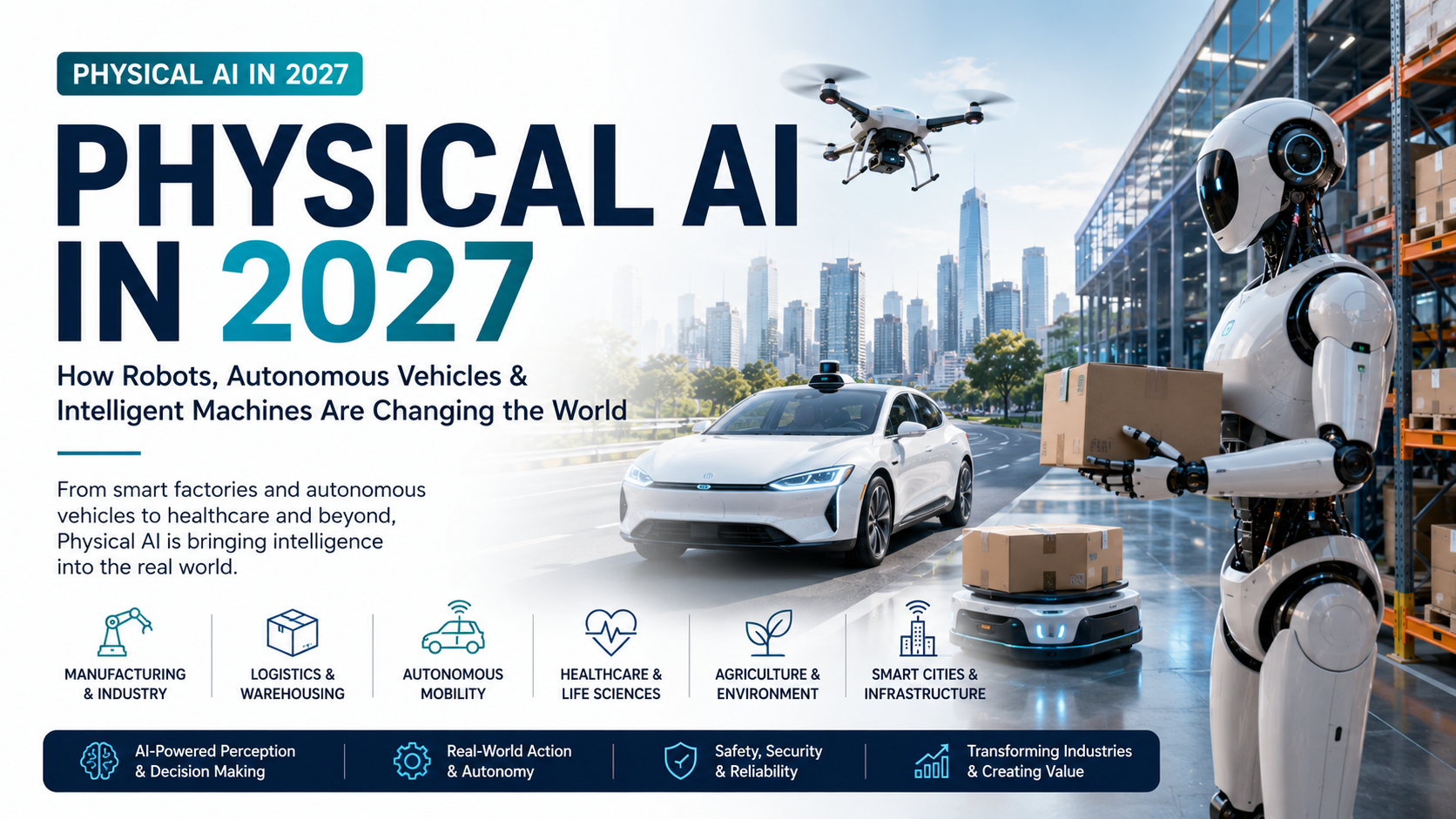
Physical AI in 2027: How Robots, Autonomous Vehicles & Intelligent Machines Are Changing the World
Artificial intelligence has spent much of the last few years living inside computers, smartphones and cloud applications.
Now AI is moving into the physical world.
Robots can see their surroundings. Autonomous vehicles can interpret roads and traffic. Industrial machines can adapt to changing conditions. Drones can navigate environments. AI-powered systems can increasingly perceive, reason and act without constant human instructions.
This emerging field is known as Physical AI.
Physical AI combines artificial intelligence with robotics, sensors, computer vision, simulation, edge computing and autonomous control systems to enable machines to interact with the physical world.
In 2027, Physical AI is expected to become one of the most important areas of technology development, particularly across robotics, manufacturing, logistics, transportation, healthcare and smart infrastructure.
Gartner's 2026 research describes Physical AI as encompassing robotics, autonomous vehicles, industrial automation and autonomous operations, while emphasizing that successful deployment depends on coordinating multiple technologies rather than relying on a single breakthrough.
What Is Physical AI?
Physical AI is artificial intelligence that enables machines to perceive, understand, make decisions and act in the physical world.
Traditional software AI primarily operates with digital information.
Physical AI connects digital intelligence to physical machines.
A Physical AI system can combine:
Cameras
Radar
LiDAR
Sensors
Computer vision
AI models
Robotics
Motion control
Edge computing
Simulation
Digital twins
Real-time decision-making
For example, a traditional industrial robot may follow a predefined sequence of movements.
A Physical AI robot could potentially:
Observe its environment.
Identify objects.
Understand the task.
Plan a sequence of actions.
Manipulate objects.
Detect changes.
Adjust its behavior.
That ability to perceive, reason and act is at the heart of Physical AI.
Why Physical AI Matters in 2027
The AI industry is entering a new phase.
The first major wave focused on digital intelligence.
The next wave is increasingly focused on embodied intelligence.
Research from Capgemini found that 79% of surveyed organizations were already engaging with Physical AI in 2026, while 27% had already deployed or were scaling Physical AI solutions.
IDC also reported that Physical AI ranked as the second-highest AI investment priority among respondents in its May 2026 survey for the following 24 months.
These developments indicate that Physical AI is moving beyond a purely experimental robotics topic.
Businesses are beginning to investigate how intelligent machines can create measurable operational value.
Physical AI vs Traditional AI
The easiest way to understand Physical AI is to compare it with conventional AI.
Traditional AI | Physical AI |
|---|---|
Operates primarily in digital environments | Operates in the physical world |
Generates information | Takes physical actions |
Uses digital data | Uses sensors and physical-world data |
Chatbots and software assistants | Robots and autonomous machines |
Mainly software-based | Hardware + software |
Errors often remain digital | Errors can have physical consequences |
Human interaction through screens | Human interaction with machines |
Physical AI does not replace traditional AI.
Instead, it extends AI into environments where machines must interact with the real world.
The Technologies Behind Physical AI
Physical AI is not a single technology.
It is a combination of multiple technologies working together.
1. Artificial Intelligence Models
AI models provide the reasoning and perception capabilities that allow machines to interpret information.
These models can process:
Images
Video
Audio
Text
Sensor data
Spatial information
2. Computer Vision
Computer vision allows machines to understand what they see.
Robots can use cameras and vision models to identify:
Objects
People
Obstacles
Products
Vehicles
Road conditions
Industrial equipment
Vision is particularly important for autonomous robots operating in changing environments.
3. Sensors
Physical AI systems need information about their environment.
Sensors can include:
Cameras
LiDAR
Radar
Ultrasonic sensors
Force sensors
Temperature sensors
Position sensors
Inertial measurement units
The combination of these sensors allows machines to build a richer understanding of their surroundings.
4. Robotics
Robotics provides the physical mechanism through which AI can act.
This includes:
Industrial robots
Mobile robots
Humanoid robots
Autonomous vehicles
Drones
Warehouse robots
Medical robots
Agricultural robots
5. Simulation
Training physical machines directly in the real world can be expensive and dangerous.
Simulation provides an alternative.
AI systems can be trained in virtual environments before being deployed into physical environments.
Simulation can help developers test:
Navigation
Object manipulation
Driving scenarios
Robot movements
Safety conditions
Rare events
NVIDIA's Physical AI research work highlights simulation, data generation, policy training and evaluation as important parts of the development workflow for autonomous vehicles and robotics.
Humanoid Robots and Physical AI
Humanoid robots are among the most visible examples of Physical AI.
Their human-like form allows them to potentially operate in environments designed for humans.
Potential applications include:
Warehouses
Manufacturing
Retail
Healthcare
Hospitality
Construction
Inspection
Household assistance
However, humanoid robots are only one part of Physical AI.
The technology also includes specialized machines designed for specific environments.
For many businesses, specialized robots may provide clearer near-term economic value than general-purpose humanoids.
Research from BCG emphasizes that robotics progress is uneven and that businesses need to distinguish deployable capabilities from impressive demonstrations.
Physical AI in Manufacturing
Manufacturing could be one of the biggest beneficiaries of Physical AI.
Factories already use robotics extensively.
Physical AI can take industrial automation further by allowing machines to adapt to changing environments.
Potential applications include:
Intelligent assembly
Quality inspection
Predictive maintenance
Machine tending
Material handling
Automated warehouses
Production optimization
Human-robot collaboration
Instead of programming every possible situation, manufacturers can increasingly use AI systems capable of responding to variations.
This could make automation more flexible.
Physical AI in Warehousing and Logistics
Warehouses are particularly attractive environments for Physical AI because they contain repetitive tasks and structured environments.
AI-powered robots can potentially:
Move products
Sort packages
Pick items
Navigate warehouses
Optimize routes
Load and unload materials
Manage inventory
Autonomous systems are already operating at scale in warehouses, factories and ports. The World Economic Forum notes that autonomous robots have increasingly moved from laboratories into real-world industrial environments.
Physical AI and Autonomous Vehicles
Autonomous vehicles are another major Physical AI application.
Self-driving systems need to:
Perceive the environment.
Identify vehicles and pedestrians.
Understand road conditions.
Predict what other road users might do.
Plan a route.
Control steering and acceleration.
React to unexpected events.
This requires AI to operate continuously in a dynamic environment.
Physical AI could therefore become an important part of the future of:
Robotaxis
Autonomous delivery vehicles
Autonomous trucks
Smart public transport
Industrial vehicles
Agricultural machinery
Physical AI in Healthcare
Healthcare could also benefit from intelligent physical machines.
Potential applications include:
Surgical robotics
Rehabilitation robots
Hospital logistics
Patient assistance
Medical inspection
Laboratory automation
Elder-care robotics
However, healthcare is also a high-risk environment.
Physical AI systems operating around patients must meet demanding requirements for safety, reliability, privacy and human oversight.
Physical AI in Agriculture
Agriculture is another area where autonomous machines can provide significant value.
AI-powered machines could support:
Crop monitoring
Precision spraying
Autonomous harvesting
Weed detection
Soil monitoring
Irrigation management
Farm equipment automation
Computer vision can help machines identify crops, weeds, pests and environmental conditions.
This could allow agricultural operations to become more precise while reducing unnecessary resource use.
Physical AI and Smart Cities
Physical AI will not be limited to robots.
It could become part of intelligent infrastructure.
Future applications may include:
Smart traffic systems
Autonomous public transport
Intelligent logistics
Infrastructure inspection
Smart buildings
Automated waste management
Energy optimization
Drone-based inspection
This creates a broader vision of cities where AI is embedded not only in software but also in the physical environment.
Physical AI and Edge Computing
Physical AI often requires decisions to happen quickly.
A robot navigating a factory cannot always wait for information to travel to a distant cloud server and return.
This makes edge AI important.
Edge computing allows AI processing to happen closer to the machine.
Advantages can include:
Lower latency
Faster decisions
Improved reliability
Reduced bandwidth requirements
Better privacy
More autonomous operation
The combination of AI models, sensors and edge computing will therefore be an important part of Physical AI architecture.
Digital Twins and Physical AI
Digital twins can create virtual representations of physical environments.
For example, a manufacturer could create a digital representation of:
A factory
A warehouse
A robot
A production line
AI systems can then use simulations to test different scenarios before changing the real-world system.
This can reduce development costs and improve safety.
Digital twins could become an important bridge between AI training and physical deployment.
The Role of World Models
One of the most important developments for Physical AI is the ability of AI systems to understand the physical world.
A machine needs more than object recognition.
It needs to understand concepts such as:
Space
Movement
Gravity
Cause and effect
Physical constraints
Human behavior
Object relationships
This is why researchers are exploring world models and other approaches designed to help AI reason about environments.
The long-term goal is to enable machines to predict what could happen before taking an action.
Physical AI and Agentic AI
Physical AI and agentic AI are closely connected.
Agentic AI focuses on systems capable of pursuing goals and taking multiple steps.
Physical AI gives those capabilities a physical body.
For example:
Agentic AI:
"Move these packages to the loading area."
Physical AI:
The robot identifies the packages, plans a route, picks them up and transports them.
Together, agentic intelligence and Physical AI could create machines capable of carrying out increasingly complex tasks.
This makes governance particularly important.
Safety: The Biggest Physical AI Challenge
Digital AI errors can often be corrected with another software update.
Physical AI is different.
A machine can cause physical damage if it behaves incorrectly.
A robot could:
Collide with a person
Drop an object
Damage equipment
Make an unsafe movement
An autonomous vehicle could encounter a dangerous situation on a public road.
NVIDIA has emphasized that Physical AI safety must extend across hardware, software, AI models, operating environments and the entire deployment lifecycle.
Gartner similarly highlights safety, orchestration, governance and cybersecurity as critical components for scaling Physical AI.
Physical AI and AI Governance
This connects directly with the growing importance of AI governance.
Organizations deploying Physical AI need to establish:
Safety standards
Human oversight
Testing procedures
Incident reporting
Cybersecurity controls
Access controls
Data governance
Model monitoring
Operational limits
Accountability
The more autonomous the machine becomes, the more important these controls become.
This is one reason Physical AI and AI governance will increasingly be discussed together.
What Will Physical AI Look Like in 2027?
By 2027, Physical AI is unlikely to mean that every household has a humanoid robot.
A more realistic scenario is gradual expansion across specific commercial environments.
We could see increasing deployment of:
Intelligent factory robots
Robots capable of adapting to variations in production environments.
Autonomous warehouse systems
Machines coordinating inventory, picking and transportation.
Advanced autonomous vehicles
More capable autonomous systems operating within defined environments.
AI-powered inspection
Drones and robots inspecting infrastructure, factories and energy assets.
Collaborative robots
Machines working more closely with humans rather than operating entirely separately.
Specialized service robots
Robots designed for healthcare, hospitality, cleaning, agriculture and logistics.
Why 2027 Could Be an Important Year for Physical AI
Several trends are converging.
AI models are becoming more capable
Better multimodal models allow machines to process different types of information.
Hardware is improving
Sensors, processors, actuators and robotic platforms continue to develop.
Simulation is becoming more sophisticated
Virtual training environments can reduce the cost of physical experimentation.
Edge computing is expanding
More AI processing can happen directly on devices.
Businesses are demanding measurable ROI
Organizations are increasingly moving beyond AI demonstrations and looking for practical business outcomes.
Omdia identified Physical AI as one of four forces expected to shape technology in 2027, alongside AI monetization, supply-chain disruption and digital sovereignty.
The Biggest Challenges Facing Physical AI
Despite the excitement, Physical AI still faces major challenges.
1. Cost
Robots and autonomous machines require hardware, maintenance and infrastructure.
2. Reliability
Machines must perform consistently in unpredictable environments.
3. Safety
Physical failures can have real-world consequences.
4. Data
AI systems require large quantities of high-quality physical-world data.
5. Computing
Advanced Physical AI can require significant computing resources.
6. Integration
Organizations must integrate robots with existing IT and operational technology systems.
7. Regulation
Autonomous machines raise complex questions around safety, liability and accountability.
8. Workforce Transformation
Employees will need new skills to work alongside intelligent machines.
Physical AI and the Future of Jobs
The rise of Physical AI will change how people work.
The impact will not necessarily be simply "robots replacing humans."
Instead, many workplaces could move toward human-machine collaboration.
Humans may increasingly focus on:
Decision-making
Creativity
Supervision
Problem-solving
Customer relationships
Complex physical tasks
AI system management
Machines may increasingly handle:
Repetitive work
Dangerous tasks
Heavy lifting
Inspection
Transportation
Data collection
Routine operations
This will create demand for workers who understand both their industry and intelligent machines.
What Businesses Should Do Now
Companies interested in Physical AI should avoid investing simply because robotics is trending.
Instead, organizations should begin with business problems.
Step 1: Identify repetitive tasks
Look for processes that are:
Repetitive
Physically demanding
Dangerous
Expensive
Difficult to staff
Step 2: Evaluate the environment
Determine whether the environment is structured enough for autonomous operation.
Step 3: Start with a pilot
Test a limited use case before attempting large-scale deployment.
Step 4: Measure ROI
Track:
Productivity
Cost savings
Downtime
Safety
Quality
Labor efficiency
Step 5: Build governance
Define safety, cybersecurity, accountability and human-oversight requirements.
Step 6: Scale carefully
Only expand once the technology has demonstrated reliable performance.
Physical AI in Asia
Asia could become one of the most important regions for Physical AI.
The region has several advantages:
Large manufacturing industries
Strong electronics supply chains
Automotive expertise
Advanced robotics markets
Large logistics networks
Major technology companies
Rapidly developing smart cities
Japan, South Korea and China already have significant robotics and manufacturing ecosystems, while Southeast Asian economies are increasingly investing in automation, electric mobility and smart infrastructure.
This creates opportunities for Physical AI across manufacturing, logistics, automotive and urban mobility.
Physical AI in Thailand
Thailand could be an interesting market for Physical AI because of its role in:
Automotive manufacturing
EV production
Electronics
Logistics
Tourism
Agriculture
Smart cities
Physical AI could eventually support applications such as:
Smart factories
Warehouse automation
Autonomous logistics
EV manufacturing
Robotics
Infrastructure inspection
Intelligent transportation
As Thailand develops its broader AI ecosystem, Physical AI could become another area where AI intersects with industrial transformation.
Physical AI and Electric Vehicles
Physical AI is also closely connected to the future of mobility.
Electric vehicles already contain sophisticated software, sensors and computing systems.
As vehicles become more autonomous, they increasingly become AI-powered physical systems.
The convergence of:
EVs + AI + sensors + connectivity + autonomous driving
could transform transportation.
This makes Physical AI particularly relevant to automotive manufacturers, mobility companies and smart-city developers.
The Future of Physical AI
The long-term vision is much larger than humanoid robots.
Physical AI could eventually become embedded into:
Vehicles
Factories
Buildings
Warehouses
Hospitals
Farms
Roads
Energy infrastructure
Consumer devices
Smart cities
AI could increasingly become an invisible intelligence layer connecting the physical and digital worlds.
The most important question will not be:
"Can we build an intelligent machine?"
It will be:
"Can we build intelligent machines that are useful, safe, reliable and economically viable?"
That distinction will determine which Physical AI technologies succeed.
Why Physical AI Matters for AI Leaders
Business leaders need to understand Physical AI because the next stage of artificial intelligence will not happen only inside software.
AI is increasingly moving into machines, vehicles and infrastructure.
This creates new opportunities for:
Technology companies
Manufacturers
Automotive companies
Robotics startups
Investors
Logistics providers
Healthcare organizations
Smart-city developers
Policymakers
AI conferences and technology events can play an important role in bringing these communities together.
At Global SI Conference, discussions around AI innovation, robotics, autonomous systems, agentic AI and the future of artificial intelligence can help businesses understand where the technology is heading.
Physical AI in 2027: Key Takeaways
Physical AI brings artificial intelligence into the real world.
It combines AI models with sensors, robotics, simulation, edge computing and autonomous systems.
Robotics, autonomous vehicles and industrial automation are major applications.
Manufacturing and logistics could be among the earliest large-scale commercial adopters.
Humanoid robots are important, but Physical AI extends far beyond humanoids.
Simulation and digital twins can accelerate development and testing.
Agentic AI could make physical machines increasingly autonomous.
Safety and governance will become essential as autonomy increases.
Asia could become an important Physical AI ecosystem because of its manufacturing and technology capabilities.
2027 could mark an important transition from AI that generates information to AI that acts in the physical world.
FAQs
What is Physical AI?
Physical AI refers to AI systems that can perceive, reason about and act in the physical world. It includes robotics, autonomous vehicles, drones, industrial automation and other intelligent machines.
What is the difference between AI and Physical AI?
Traditional AI primarily operates with digital information, while Physical AI connects AI intelligence to physical systems that can sense and act in the real world.
Are humanoid robots Physical AI?
Yes. Humanoid robots are one type of Physical AI, but the field also includes autonomous vehicles, industrial robots, drones, smart machines and autonomous infrastructure.
What industries will benefit from Physical AI?
Manufacturing, logistics, automotive, healthcare, agriculture, construction, energy and smart cities are among the sectors that could benefit significantly.
Will Physical AI replace human workers?
Physical AI is more likely to change the way many people work than simply eliminate all human roles. Humans may increasingly work alongside intelligent machines, with robots handling repetitive, dangerous or physically demanding tasks.
Why is Physical AI important in 2027?
AI is increasingly moving from digital applications into real-world machines. Improvements in AI models, sensors, robotics, simulation and edge computing are making more advanced autonomous systems possible.
What are the biggest challenges of Physical AI?
Major challenges include safety, reliability, cost, data, computing, cybersecurity, regulation, integration and workforce transformation.
How does Physical AI relate to autonomous vehicles?
Autonomous vehicles are a major Physical AI application because they must perceive their environment, make decisions and physically control a vehicle in real time.
Conclusion
Physical AI represents the next major frontier of artificial intelligence.
The first wave of AI transformed information.
The next wave could transform the physical world.
From intelligent factories and autonomous vehicles to warehouse robots, smart infrastructure and advanced machines, Physical AI could fundamentally change how businesses operate.
But success will depend on more than building increasingly intelligent machines.
Organizations will need to combine AI, robotics, safety, governance, infrastructure and business strategy.
As we move toward 2027, the most important AI systems may no longer be the ones we interact with through a screen.
They may be the ones moving, driving, building, inspecting and working alongside us in the real world.