Artificial intelligence is moving through a major transition.
For the past several years, generative AI has dominated the conversation. AI systems can write articles, generate images, summarize documents, create software code, analyze information and answer complex questions. Generative AI has rapidly moved from an emerging technology into everyday consumer and business applications.
But a new phase of AI is gaining attention: agentic AI.
Instead of simply generating a response to a prompt, agentic AI is designed to pursue a goal, reason through multiple steps, use tools, interact with software and systems, and take actions with a degree of autonomy.
This shift creates an important question for businesses, technology leaders, startups and researchers:
What is the difference between generative AI and agentic AI — and what comes next?
The answer is not that one technology simply replaces the other. In many cases, agentic AI builds on generative AI capabilities. Large language models and other foundation models can provide the reasoning and generation capabilities inside an agentic system, while tools, memory, workflows, permissions and guardrails allow that system to act.
As AI develops toward 2027 and beyond, understanding this distinction will become increasingly important for organizations planning their AI strategies.
What Is Generative AI?
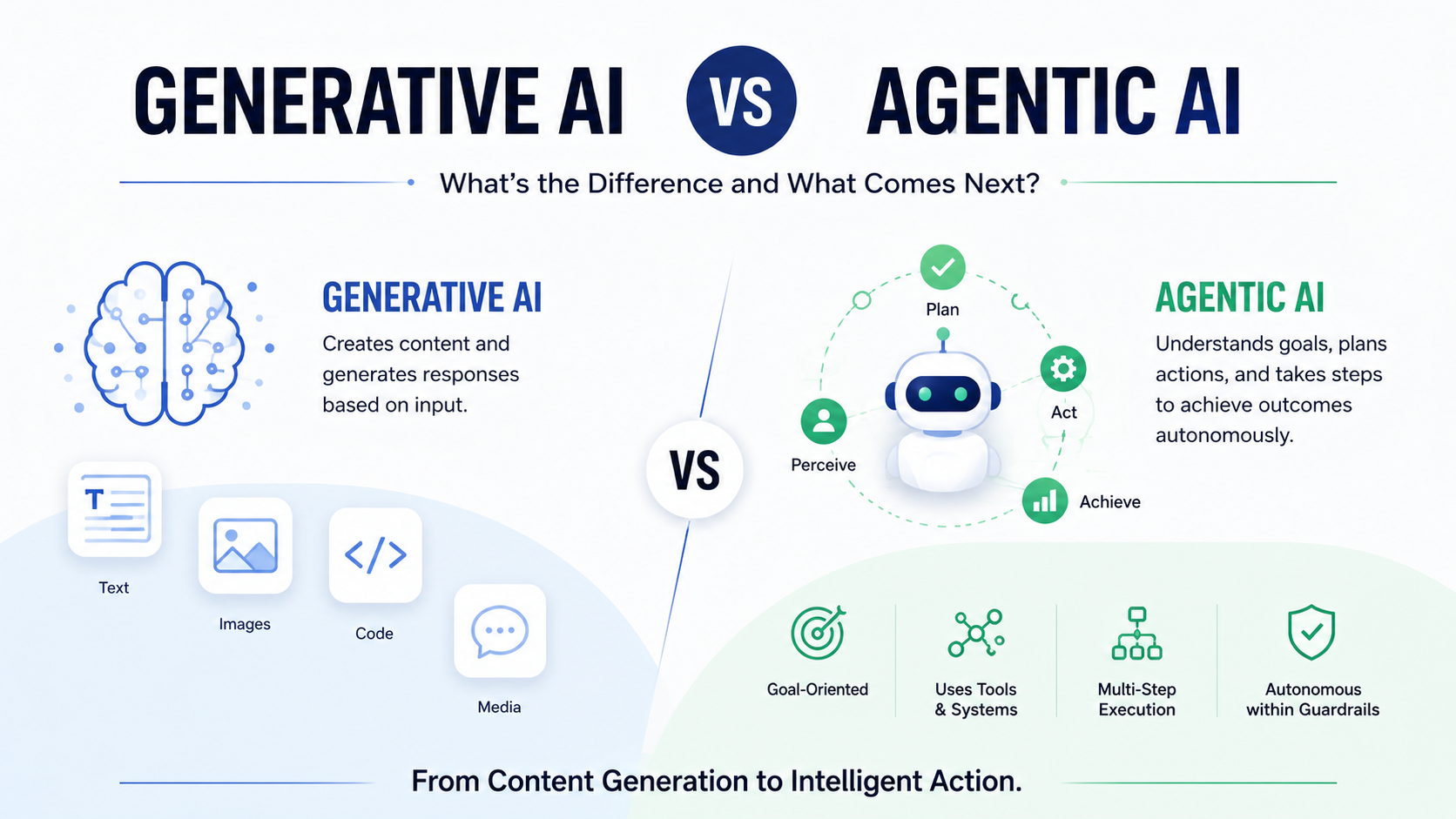
Generative AI refers to artificial intelligence systems capable of creating new content based on patterns learned from large datasets.
Depending on the model and application, generative AI can produce:
Text
Images
Video
Audio
Software code
Presentations
Summaries
Reports
Marketing content
Synthetic data
Designs
Conversational responses
A user generally provides an instruction, question or prompt, and the AI generates an output.
For example:
"Create a marketing plan for a new electric vehicle."
A generative AI system might produce the marketing strategy, campaign ideas, customer segments, messaging and content.
The system is highly capable of generating information, but traditional generative AI applications often remain response-oriented.
The user asks.
The AI responds.
The user decides what to do next.
That distinction becomes important when comparing generative AI with agentic AI.
What Is Agentic AI?
Agentic AI refers to AI systems designed to pursue goals and perform tasks with a greater degree of independence.
An agent can potentially:
Understand a goal
Break the goal into smaller tasks
Plan a sequence of actions
Gather information
Use external tools
Make decisions within defined boundaries
Execute actions
Evaluate results
Adjust its approach
Stop when the task is completed or human intervention is required
For example, instead of asking:
"Write a report about our sales performance."
A business might ask an AI agent:
"Analyze this quarter's sales, identify major changes, compare performance with the previous quarter, investigate unusual results, prepare a report and send it to the sales leadership team for review."
The second request involves a workflow rather than simply generating content.
The agent may need to access databases, analyze information, use spreadsheets, create a report and potentially interact with other business systems.
This is the fundamental shift:
Generative AI primarily creates. Agentic AI is designed to accomplish.
Generative AI vs Agentic AI: The Key Difference
The simplest way to understand the difference is to look at the role each technology plays.
Generative AI | Agentic AI |
|---|---|
Generates content | Pursues goals |
Responds to prompts | Executes workflows |
Primarily output-focused | Outcome-focused |
Usually requires user direction | Can operate through multiple steps |
Creates text, images, code and more | Uses models, tools and systems to perform tasks |
Often single interaction | Often multi-step |
User controls next action | AI can determine next steps within guardrails |
Primarily creates information | Can create information and take actions |
However, the distinction is not absolute.
An agentic system can use generative AI as one of its core components.
For example, an AI agent may use a language model to understand a request, generate a plan, interpret documents, communicate with users and decide which tool to call next.
Therefore, the future of AI is likely to involve generative capabilities and agentic capabilities working together.
Generative AI Is the Brain Behind Many AI Experiences
Generative AI has dramatically expanded what people can do with software.
Instead of navigating complicated interfaces, users can increasingly communicate with technology using natural language.
For example:
"Summarize this report."
"Write a product description."
"Explain this financial statement."
"Create a presentation."
"Generate code for this application."
"Translate this document."
"Analyze these customer reviews."
This makes generative AI particularly valuable for knowledge work.
Organizations are already applying generative AI across areas such as marketing, software development, customer service, research, education and content creation.
The rapid adoption of generative AI demonstrates the demand for natural-language interfaces and AI-assisted work.
But generating an answer is only one part of many business processes.
The next opportunity is connecting that intelligence to action.
Agentic AI Moves From Answers to Actions
The defining characteristic of agentic AI is the ability to move beyond generating an answer and participate in a workflow.
Consider customer service.
A generative AI chatbot might answer:
"Your order is currently in transit and is expected to arrive tomorrow."
An agentic customer-service system could potentially:
Retrieve the customer's order
Check shipping information
Identify a delivery delay
Review company policies
Contact the shipping system
Offer an approved solution
Update the customer record
Escalate the issue when necessary
The difference is not simply intelligence.
It is agency within a controlled environment.
Agentic systems can combine AI models with tools, business data, APIs, applications and approval mechanisms to complete more complex tasks.
How Agentic AI Systems Work
A typical agentic AI architecture can contain several components.
1. AI Model
The underlying model interprets information, reasons about the task and generates decisions or outputs.
Large language models are commonly used for language-heavy agent applications.
2. Instructions and Goals
The system receives a goal and a set of instructions defining what it should accomplish and what constraints it must follow.
3. Tools
Tools allow an agent to interact with external systems.
These can include:
Databases
Search systems
APIs
CRM platforms
Financial systems
Calendars
Email
Enterprise software
Code execution environments
Documents
4. Memory and Context
Agents may need information from previous steps to maintain context throughout a task.
5. Orchestration
More advanced systems can coordinate multiple specialized agents or workflows.
For example:
Research agent
Data analysis agent
Writing agent
Compliance agent
Customer service agent
A manager or orchestration layer can determine which agent should handle each part of a larger task.
6. Guardrails
Because agents can take actions, organizations need boundaries.
Guardrails can determine:
Which tools an agent can access
What information it can use
What actions require approval
What data it can modify
When a human must intervene
What activities are prohibited
This makes governance an essential part of agentic AI.
Real-World Applications of Generative AI
Generative AI is already being used across many industries.
Marketing
AI can generate:
Campaign ideas
Blog articles
Social media posts
Product descriptions
Advertisements
Customer messaging
Software Development
Generative AI can help developers:
Write code
Explain code
Generate tests
Debug problems
Create documentation
Convert code between languages
Education
Generative AI can support:
Personalized explanations
Study materials
Lesson planning
Question generation
Tutoring experiences
Healthcare
Potential applications include:
Document summarization
Clinical information support
Research assistance
Administrative workflows
Research
Researchers can use generative AI to:
Summarize literature
Analyze documents
Generate hypotheses
Assist with coding
Explore datasets
The major value proposition is augmentation — helping people create and process information faster.
Real-World Applications of Agentic AI
Agentic AI expands these possibilities by connecting intelligence to workflows.
Customer Service Agents
Agents can potentially manage customer issues from initial request through resolution, escalating cases when human involvement is necessary.
Software Engineering Agents
AI agents can work across software-development workflows by analyzing requirements, writing code, running tests and investigating errors.
Business Operations
Agents can monitor processes, identify exceptions and initiate predefined actions.
Sales
An AI sales agent could potentially research prospects, update CRM records, prepare account summaries and assist with follow-up workflows.
Finance
Agentic systems could support financial operations by collecting information, reconciling records and identifying unusual transactions for human review.
Research
Research agents can potentially search information, compare sources, organize findings and produce structured reports.
IT Operations
AI agents can monitor systems, investigate alerts, identify possible causes and initiate approved remediation workflows.
The common theme is that the AI becomes part of the process, rather than remaining only an interface for generating content.
Generative AI vs Agentic AI in Business
For business leaders, the difference can be understood through a simple question:
Is the AI helping an employee perform a task, or is the AI participating in the workflow itself?
Generative AI is particularly useful for employee assistance.
For example:
"Summarize these 50 customer reviews."
Agentic AI becomes more relevant when the task includes multiple steps:
"Monitor customer reviews, identify emerging complaints, categorize them, investigate the most serious issues and create an escalation report."
The second workflow requires continuous observation, decision-making and action.
This does not mean every organization needs autonomous AI.
In many cases, generative AI may be the more appropriate solution.
The right architecture depends on the complexity, risk and business value of the task.
Why Agentic AI Is Becoming Important
The growth of agentic AI reflects a broader change in the AI industry.
AI systems are increasingly moving from:
Content → Context → Reasoning → Action
Generative AI made AI accessible as a content-generation technology.
The next stage connects AI to business context and operational systems.
Current research shows that enterprise agent adoption is still relatively early. Stanford's 2026 AI Index reports that agent use remained in the single digits across most business functions, while Gartner reported that 17% of organizations surveyed had deployed AI agents and more than 60% expected to do so within two years. These figures indicate strong interest, but also show that widespread production deployment is still developing.
The Rise of the AI Workforce
One of the most important implications of agentic AI is the emergence of what could be described as a digital workforce.
Instead of using AI only as an assistant, organizations may increasingly assign AI systems specific responsibilities.
For example:
Human employee:
"Manage customer onboarding."
AI agents:
Collect customer information
Verify documents
Check requirements
Create records
Schedule meetings
Generate onboarding materials
Monitor outstanding tasks
The human remains responsible for the broader business relationship while AI handles defined portions of the workflow.
This model could create new forms of collaboration between humans and AI.
Multi-Agent Systems
The next development beyond individual agents may be multi-agent systems.
Rather than asking one AI system to perform every task, organizations can create specialized agents.
For example:
Research Agent
Finds and analyzes information.
Data Agent
Queries databases and analyzes datasets.
Strategy Agent
Evaluates options and creates recommendations.
Execution Agent
Performs approved actions.
Compliance Agent
Checks outputs against organizational policies.
These agents can potentially work together through an orchestration layer.
This architecture could become increasingly important for complex enterprise workflows.
Generative AI and Agentic AI Are Not Competitors
It is tempting to frame the discussion as:
Generative AI vs Agentic AI
But the future is more likely to be:
Generative AI + Agentic AI
Generative AI provides capabilities such as language understanding, content creation and reasoning.
Agentic architecture provides:
Goals
Planning
Tools
Memory
Orchestration
Workflow execution
Permissions
Guardrails
Together, these technologies can create systems that do more than answer questions.
They can help organizations accomplish tasks.
The Biggest Challenge: Reliability
More autonomy creates more responsibility.
If an AI system generates an inaccurate paragraph, a person may notice and correct it.
If an AI agent incorrectly changes a database record, sends an inappropriate message or initiates an incorrect transaction, the consequences can be much greater.
This is why reliability becomes increasingly important as AI moves from generation to action.
AI agents need mechanisms for:
Testing
Monitoring
Evaluation
Permissions
Human approval
Logging
Error handling
Security
Identity management
Stanford's 2026 AI Index reports that AI agents have improved substantially on computer-use benchmarks, but still fail a significant share of structured tasks. This reinforces the importance of human oversight and evaluation for higher-risk applications.
AI Governance Becomes More Important
Generative AI already creates governance challenges around:
Privacy
Copyright
Accuracy
Bias
Data security
Transparency
Agentic AI introduces additional questions.
For example:
Who authorized the agent to take an action?
What systems can the agent access?
What happens when the agent makes a mistake?
Can a human stop the process?
How are actions logged?
How are permissions managed?
What happens when multiple agents interact?
As AI systems gain more autonomy, governance cannot remain an afterthought.
It needs to be part of the architecture.
The Infrastructure Challenge
Agentic AI can also require significantly different infrastructure from traditional AI applications.
A simple chatbot may receive a prompt, generate an answer and end the interaction.
An agent may:
Receive a goal
Search multiple sources
Call several APIs
Query databases
Execute tools
Review results
Ask another agent for help
Generate an output
Perform an approved action
One user request can therefore generate a much larger chain of model and system activity.
Google Cloud's 2026 State of AI Infrastructure report found that 83% of surveyed organizations said they require infrastructure upgrades to support production-grade agentic AI. The report also identified security, governance and MLOps among the major challenges organizations face.
This suggests that agentic AI is not simply a software upgrade.
It can require changes across the technology stack.
What Comes Next for Generative and Agentic AI?
Several developments are likely to shape the next phase of AI.
1. More Specialized AI Agents
Instead of one general-purpose assistant, organizations may use specialized agents for specific departments and workflows.
2. Multi-Agent Collaboration
Multiple agents may collaborate to solve complex problems.
3. Better AI Memory
Agents will increasingly need persistent context to understand users, projects and business processes.
4. Greater Tool Integration
Agents will become more useful as they connect to enterprise applications, databases and external services.
5. AI-Native Software
Traditional software may increasingly be redesigned around natural-language interaction and autonomous workflows.
6. Human-Agent Collaboration
The future is unlikely to be entirely human or entirely autonomous.
Instead, many organizations may develop systems where humans define objectives, approve important actions and manage exceptions while AI handles repetitive execution.
7. Stronger AI Governance
As AI gains access to more systems, identity, permissions, monitoring and auditability will become increasingly important.
8. Physical AI and Robotics
Agentic intelligence may eventually move beyond digital environments.
Robots, autonomous machines and intelligent vehicles can combine perception, reasoning and action in the physical world.
This could connect agentic AI with manufacturing, logistics, mobility, healthcare, smart cities and industrial automation.
What Does This Mean for Businesses in 2027?
Businesses should not adopt agentic AI simply because it is the latest AI trend.
A better approach is to identify workflows where autonomy could produce measurable value.
Organizations can begin by asking:
Which tasks are repetitive?
Identify processes that consume significant employee time.
Which workflows have clear objectives?
Agents perform better when the desired outcome can be clearly defined.
Which systems can safely be connected?
Determine what data and tools an AI system actually needs.
Where is human approval necessary?
High-impact actions should generally have appropriate controls.
How will success be measured?
Define metrics such as:
Time saved
Cost reduction
Error rates
Customer satisfaction
Revenue impact
Productivity
Completion rate
The goal should not be "use more AI."
The goal should be create better outcomes with AI.
How Startups Can Use the Generative-to-Agentic Shift
The transition from generative AI to agentic AI could also create opportunities for startups.
Entrepreneurs can build specialized AI systems for industries where workflows are complex and fragmented.
Potential opportunities include:
AI financial operations
AI legal research
AI healthcare administration
AI sales operations
AI logistics
AI procurement
AI cybersecurity
AI software development
AI customer service
AI research assistants
AI manufacturing systems
Instead of building another general chatbot, startups can focus on solving a specific workflow problem.
The opportunity is moving from:
"AI that can answer."
to:
"AI that can get something done."
Why Researchers Are Focused on Agentic AI
For researchers, agentic AI introduces a wide range of questions.
How should agents plan?
How can they reason over long sequences?
How can their actions be evaluated?
How can they learn from mistakes?
How can multiple agents coordinate?
How should memory work?
How can agents remain aligned with user goals?
How should autonomy be measured?
These questions sit at the intersection of machine learning, natural language processing, robotics, human-computer interaction, AI safety and systems engineering.
The field is therefore broader than simply improving language models.
It is about designing intelligent systems capable of operating within real environments.
Generative AI vs Agentic AI: Quick Comparison
Category | Generative AI | Agentic AI |
|---|---|---|
Primary purpose | Generate content | Accomplish goals |
Interaction | Prompt and response | Goal and workflow |
Autonomy | Usually limited | Higher within defined boundaries |
Planning | Usually limited | Multi-step planning |
Tools | May use tools | Often central to operation |
Memory | Optional | Often important |
Workflow execution | Limited | Core capability |
Human involvement | Frequently directs each step | Can supervise and approve |
Output | Content or information | Actions and outcomes |
Main value | Productivity and creation | Automation and execution |
The Future of AI Is Becoming More Action-Oriented
The evolution of artificial intelligence can be viewed as a progression.
First: AI Recognized
AI learned to identify patterns in data.
Then: AI Generated
Generative AI learned to create text, images, audio, code and other content.
Now: AI Reasons and Acts
Agentic AI is pushing AI systems toward planning, tool use and workflow execution.
Next: AI Collaborates
The emerging direction is toward ecosystems of AI systems, humans and intelligent software working together.
The long-term outcome could be a world where AI is not just a tool that people open when they need assistance.
AI could increasingly become part of the infrastructure through which work is performed.
Why This Matters for the Future of Artificial Intelligence
The distinction between generative AI and agentic AI is ultimately about the role AI plays.
Generative AI primarily helps us create.
Agentic AI aims to help us accomplish.
Neither eliminates the need for the other.
In fact, increasingly capable generative models can become the intelligence layer inside agentic systems. Agents then add tools, workflows, context, memory, permissions and action capabilities around those models.
This combination could reshape enterprise software, research, customer service, software development, education, manufacturing, mobility and many other industries.
The transition will not happen overnight.
Agentic AI still faces challenges involving reliability, security, infrastructure, governance, cost and evaluation. Current industry research also shows a significant gap between experimentation and scaled deployment.
But the direction is clear: AI is moving beyond simply generating answers toward systems that can participate in completing real-world tasks.
Global Super Intelligence Conference 2027
As generative AI evolves toward more autonomous and agentic systems, conversations around the future of artificial intelligence are becoming increasingly important.
The Global Super Intelligence Conference 2027 in Bangkok brings together the broader AI ecosystem around emerging technologies, innovation, business applications and the future direction of intelligent systems.
For AI leaders, researchers, startups, technology companies and innovators, discussions around generative AI, agentic AI, autonomous systems, AI infrastructure, AI safety, governance and superintelligence are becoming increasingly relevant.
The next phase of AI will not be defined only by what models can generate.
It will also be defined by what intelligent systems can understand, decide, coordinate and accomplish.
Frequently Asked Questions
What is the main difference between generative AI and agentic AI?
Generative AI primarily creates content or information in response to instructions. Agentic AI is designed to pursue goals through multiple steps, potentially using tools, data and external systems to complete tasks.
Is agentic AI the same as generative AI?
No. Agentic AI and generative AI are related but different concepts. An agentic system can use generative AI models as its reasoning or generation component while adding tools, workflows, memory and action capabilities.
Is ChatGPT generative AI or agentic AI?
ChatGPT can be used for generative AI tasks such as writing, summarization and question answering. Depending on the product configuration and available tools, AI systems can also support agentic workflows involving tools and multi-step task execution.
Which is more advanced, generative AI or agentic AI?
They represent different capabilities rather than a simple ranking. Generative AI focuses on creating content, while agentic AI focuses on accomplishing goals through actions and workflows.
Why is agentic AI important for businesses?
Agentic AI could automate multi-step workflows that previously required employees to move information between applications, analyze data and perform repetitive actions.
What are the risks of agentic AI?
Important risks include incorrect actions, security vulnerabilities, excessive permissions, unreliable decisions, data exposure, insufficient monitoring, unclear accountability and unexpected costs.
Will AI agents replace employees?
The impact will vary by industry and task. AI agents are more likely to automate or change specific workflows than replace every aspect of a job. Human judgment, oversight, creativity, relationships and accountability can remain important.
What comes after agentic AI?
Potential future developments include multi-agent systems, AI-native software, persistent AI memory, physical AI, robotics, autonomous systems and increasingly sophisticated human-AI collaboration.
Conclusion
The debate between generative AI vs agentic AI is really a discussion about how artificial intelligence is evolving.
Generative AI transformed the way people create and interact with information.
Agentic AI is extending that transformation toward workflows, decisions and actions.
The future may not be about choosing between the two.
Instead, organizations may combine powerful generative models with agents that can understand objectives, use tools, coordinate processes and operate within carefully designed boundaries.
As AI becomes more capable, the important question will shift from:
"What can AI generate?"
to:
"What can AI help us accomplish?"
That shift could define one of the most important stages in the evolution of artificial intelligence.