AI Governance in 2027: How Businesses Can Build Trustworthy and Responsible AI
Artificial intelligence is moving rapidly from experimentation into everyday business operations. Companies are using generative AI, machine learning and increasingly autonomous AI agents for customer service, marketing, software development, finance, operations and decision-making.
But as AI becomes more powerful, businesses face a critical question:
How can organizations use AI responsibly while controlling its risks?
This is where AI governance becomes essential.
AI governance refers to the policies, processes, responsibilities and controls organizations use to make sure artificial intelligence is developed and deployed safely, ethically, transparently and in alignment with business objectives and applicable requirements.
In 2027, AI governance is likely to become a core component of enterprise AI strategy rather than a specialist compliance topic.
For businesses in Thailand and across Southeast Asia, this is particularly important as AI adoption accelerates and organizations move from pilot projects toward larger-scale implementation.
What Is AI Governance?
AI governance is the framework an organization uses to manage the opportunities and risks associated with artificial intelligence.
A strong AI governance framework can address:
AI strategy
Data governance
Privacy
Cybersecurity
Model risk
Bias and fairness
Transparency
Human oversight
Accountability
AI procurement
Third-party AI systems
Generative AI
Agentic AI
AI monitoring and evaluation
The goal is not simply to restrict AI.
Instead, effective governance should help organizations use AI confidently while managing its risks.
Thailand's National AI Strategy has already identified AI governance as an important part of responsible AI development. Thailand's AI Governance Center (AIGC) supports research, organizational consultation, awareness and collaboration around AI governance.
Why AI Governance Matters in 2027
The scale and complexity of AI systems are increasing.
Businesses are no longer using AI only for simple automation. Organizations are beginning to deploy systems that can generate content, analyze sensitive information, make recommendations and perform multi-step tasks.
This creates several important risks.
1. AI Can Make Incorrect Decisions
AI systems can produce inaccurate or misleading results.
Generative AI can also generate convincing information that is incorrect, sometimes referred to as hallucination.
Businesses therefore need processes for:
Human review
Testing
Validation
Monitoring
Error reporting
Model evaluation
2. AI Can Create Privacy Risks
AI systems often process large quantities of information.
Depending on the application, this could include:
Customer information
Employee information
Financial data
Business documents
Personal communications
Healthcare information
Proprietary company data
Organizations need clear policies governing what information can be entered into AI systems and how that information can be stored, processed and shared.
3. AI Can Introduce Bias
AI systems learn from data.
If the underlying data contains bias, the resulting AI system may reproduce or amplify it.
This can become particularly important when AI is used for:
Recruitment
Lending
Insurance
Healthcare
Education
Customer segmentation
Risk assessment
AI governance therefore needs mechanisms for identifying and managing potential bias.
AI Governance vs AI Ethics
AI governance and AI ethics are closely connected, but they are not exactly the same.
AI ethics focuses on principles such as:
Fairness
Transparency
Human dignity
Accountability
Privacy
Safety
AI governance turns these principles into practical organizational processes.
For example:
AI ethics:
"AI decisions should be fair."
AI governance:
"The company will conduct bias testing before deploying high-impact AI systems and will review performance regularly."
This distinction is important because responsible AI requires more than publishing ethical principles.
Organizations need processes, people and accountability.
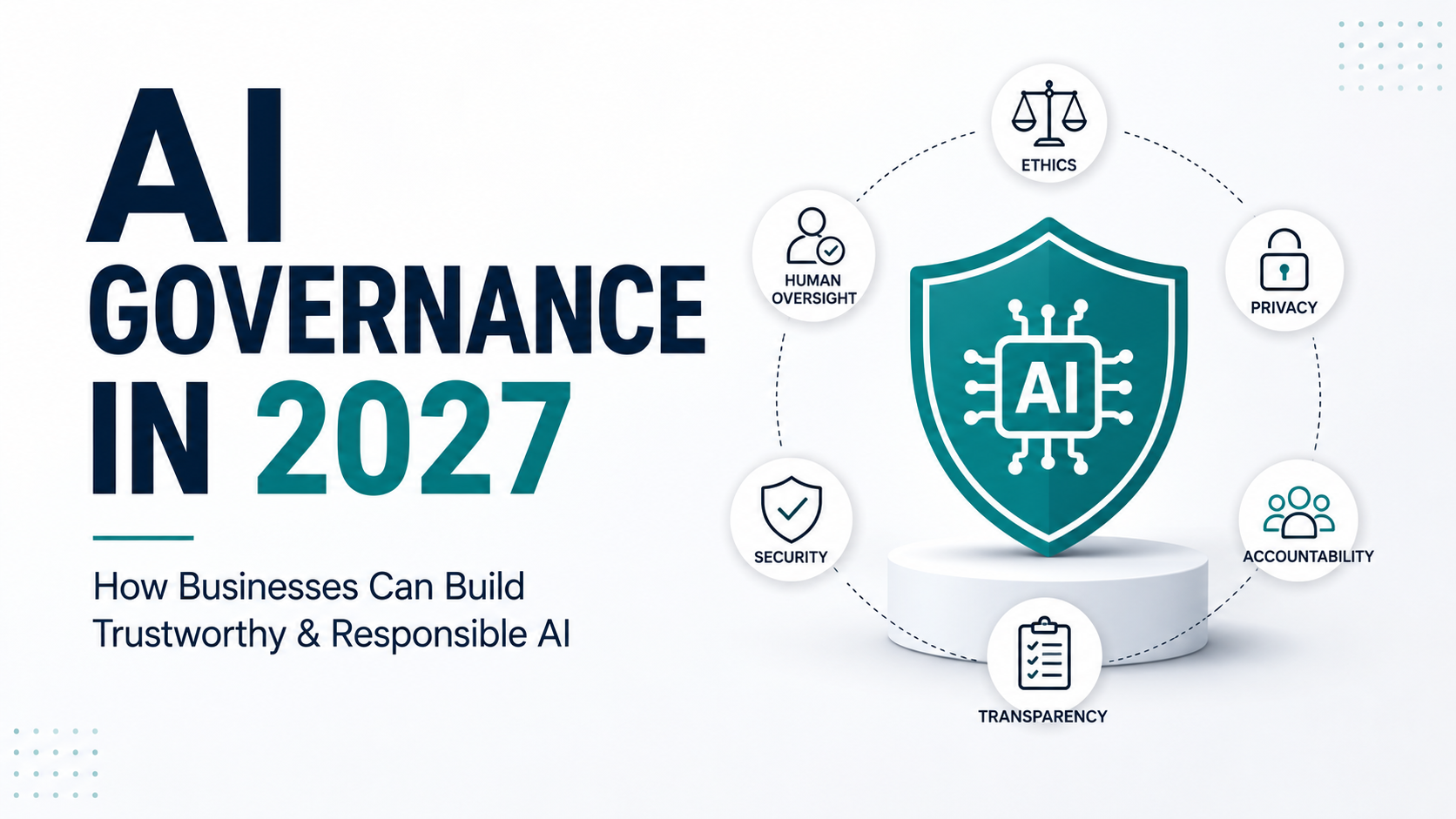
The Main Pillars of AI Governance in 2027
A mature AI governance strategy should cover several interconnected areas.
1. AI Strategy
Organizations should define why they are using AI and what outcomes they expect.
Before deploying an AI system, businesses should ask:
What business problem are we solving?
Why is AI appropriate?
What are the expected benefits?
What could go wrong?
Who owns the AI system?
How will success be measured?
AI governance should therefore be connected directly to business strategy.
2. Data Governance
AI depends heavily on data.
Organizations need to understand:
Where data comes from
Whether the data is accurate
Who can access it
How it is stored
How long it is retained
Whether it can legally be used
Whether sensitive information is being processed
Poor data governance can create poor AI outcomes.
3. Privacy
Privacy should be considered throughout the AI lifecycle.
Companies should establish rules around:
Personal data
Sensitive data
Data retention
Data access
Third-party AI platforms
Employee use of generative AI
Customer-facing AI applications
Organizations should also ensure their AI practices align with applicable privacy requirements.
4. AI Security
AI introduces new cybersecurity considerations.
Businesses need to consider risks such as:
Prompt injection
Data leakage
Unauthorized AI access
Model manipulation
Malicious inputs
Supply-chain risks
Compromised third-party models
Security teams will increasingly need to work together with AI and data teams.
5. Transparency and Explainability
People should understand when they are interacting with AI, particularly when AI has a meaningful impact on them.
Organizations may need to explain:
What the AI system does
What information it uses
How decisions are made
What limitations exist
When human intervention is available
The level of explanation should depend on the application and its potential impact.
6. Human Oversight
Human oversight will remain one of the most important components of responsible AI.
Businesses should determine when humans must:
Review AI outputs
Approve decisions
Override AI recommendations
Investigate errors
Stop an AI system
This becomes especially important as organizations adopt agentic AI, where AI systems can perform multiple actions with less direct human intervention.
AI Governance and Generative AI
Generative AI has made AI governance more urgent.
Large language models can generate:
Text
Images
Software code
Audio
Video
Business reports
Marketing materials
Research summaries
However, organizations must consider risks involving accuracy, intellectual property, privacy, security and inappropriate content.
NIST's Generative AI Profile provides organizations with a structured approach for identifying and managing risks associated with generative AI across its lifecycle.
Businesses can use this type of risk-management approach when developing internal generative AI policies.
AI Governance and Agentic AI
One of the biggest governance challenges in 2027 may come from agentic AI.
Traditional AI may generate a recommendation or answer.
An AI agent can potentially:
Understand a goal
Create a plan
Use tools
Access information
Perform actions
Evaluate results
Continue working toward the goal
This creates new governance questions.
Who is responsible for an AI agent's actions?
What permissions should an AI agent receive?
What happens if an agent makes a mistake?
When should an agent require human approval?
How can companies audit an agent's actions?
These questions make AI governance increasingly important as autonomous AI systems become more capable.
AI Governance in Thailand
Thailand has been developing AI governance capabilities as part of its broader national AI strategy.
Thailand's National AI Strategy and Action Plan 2022–2027 includes responsible AI development and governance among its priorities.
The country's AI Governance Center has a role in supporting organizations with AI governance, responsible AI practices, awareness and collaboration between public and private sectors.
This is particularly relevant as Thai businesses increase their use of AI.
Recent research from NECTEC found that 53.7% of surveyed Thai organizations had already adopted AI, while many organizations were still developing their AI capabilities.
At the same time, AI readiness remains uneven, making governance and organizational capability important parts of Thailand's AI development.
What Should an AI Governance Framework Include?
Businesses developing an AI governance framework in 2027 should consider the following components.
Area | Key Question |
|---|---|
AI Strategy | Why are we using AI? |
Data | Is our data accurate and appropriate? |
Privacy | Are we protecting personal information? |
Security | Can the AI system be attacked or misused? |
Ethics | Is the system fair and responsible? |
Transparency | Can users understand its role? |
Human Oversight | When must humans intervene? |
Risk Management | What can go wrong? |
Monitoring | How do we detect problems? |
Accountability | Who owns the system? |
Vendor Management | What are the risks of third-party AI? |
Incident Management | What happens when AI fails? |
How Businesses Can Build an AI Governance Framework
Companies do not need to create a complicated framework overnight.
A practical approach can begin with several steps.
Step 1: Create an AI Inventory
Identify all AI systems currently being used by employees and business units.
This should include:
Official AI applications
Internal AI tools
Generative AI platforms
Machine-learning systems
Third-party AI services
AI agents
Many organizations may discover that employees are already using AI tools that have not been formally approved.
Step 2: Classify AI Risk
Not every AI application has the same level of risk.
A company could classify systems as:
Low risk
Content assistance, brainstorming and productivity tools.
Medium risk
Customer-service automation, forecasting and business recommendations.
High risk
Systems affecting employment, finance, healthcare, legal decisions or other sensitive areas.
The higher the potential impact, the stronger the governance requirements should be.
Step 3: Define Roles and Responsibilities
AI governance should have clear ownership.
Possible roles include:
AI Governance Committee
Chief Information Officer
Chief Technology Officer
Chief Data Officer
Chief Risk Officer
Legal and compliance teams
Cybersecurity teams
Business-unit leaders
AI developers
Data scientists
Everyone should understand who is responsible for decisions at each stage.
Step 4: Establish AI Policies
Organizations should create practical policies covering issues such as:
Approved AI tools
Data that employees may enter into AI systems
Human review
AI-generated content
Security requirements
Model testing
Vendor management
AI incident reporting
Policies should be understandable enough for employees to follow.
Step 5: Test AI Before Deployment
AI systems should be tested before they are released into production.
Testing can examine:
Accuracy
Bias
Security
Reliability
Privacy
Robustness
Hallucinations
Failure scenarios
Testing should continue after deployment rather than ending when an AI system goes live.
The Role of AI Standards and Frameworks
Organizations do not have to build their entire governance model from scratch.
International frameworks can provide useful guidance.
One example is the NIST AI Risk Management Framework, which organizes AI risk management around four core functions:
Govern → Map → Measure → Manage
The framework is designed to help organizations incorporate trustworthiness considerations into the design, development, use and evaluation of AI systems.
Organizations can adapt such frameworks to their own industry, risk profile and regulatory environment.
AI Governance for Small and Medium Businesses
AI governance is not only for large corporations.
Small and medium-sized businesses should also establish basic controls.
A smaller company could start with:
An approved AI-tools list
Employee AI-use guidelines
Data-protection rules
Human review requirements
Vendor checks
AI incident reporting
Regular review of AI systems
The objective should be proportionate governance, rather than unnecessary bureaucracy.
Why AI Governance Can Become a Competitive Advantage
AI governance is often viewed as a compliance requirement.
But good governance can also create competitive advantages.
Greater customer trust
Customers may be more willing to use AI-powered services when businesses clearly explain how AI is used.
Better AI decisions
Testing and monitoring can reduce errors.
Faster enterprise adoption
A clear governance framework can make it easier for teams to deploy approved AI solutions.
Reduced risk
Organizations can identify problems before they become expensive incidents.
Better investment decisions
Governance can help companies determine which AI projects are worth scaling.
AI Governance in 2027: What Will Change?
The next stage of AI governance will likely move beyond basic policies.
Organizations will increasingly focus on continuous AI governance.
This means monitoring AI systems throughout their lifecycle.
Businesses may increasingly use:
Automated AI evaluations
Model monitoring
AI risk dashboards
Audit trails
AI inventories
Automated compliance checks
Model testing
Human-in-the-loop controls
AI incident-management systems
Governance will become less about creating a document and more about building an ongoing operating system for responsible AI.
The Biggest AI Governance Challenges in 2027
Despite growing awareness, organizations will face several challenges.
Lack of AI Skills
Companies need employees who understand both AI technology and risk management.
Rapid Technology Change
AI systems are evolving faster than many traditional governance processes.
Shadow AI
Employees may use AI tools without informing IT or security teams.
Third-Party AI
Companies increasingly depend on external models, APIs and platforms.
Measuring AI Risk
It can be difficult to quantify the probability and potential impact of AI failures.
Balancing Innovation and Control
Too little governance can increase risk.
Too much bureaucracy can slow innovation.
Successful organizations will need to find the right balance.
AI Governance and the Future of Business
AI governance will increasingly become part of corporate strategy.
As businesses move toward more autonomous AI, organizations will need to answer a fundamental question:
How much authority should we give AI?
The answer will differ by industry and application.
A marketing assistant may operate with relatively little oversight.
An AI system making financial, healthcare or employment-related recommendations may require significantly stronger controls.
The future of responsible AI will therefore depend on risk-based governance rather than a single universal rule.
Why AI Leaders Should Discuss AI Governance in 2027
AI governance is becoming a board-level conversation.
Executives need to understand:
Where AI creates value
Where AI creates risk
How AI should be governed
How employees should use AI
How AI systems should be monitored
How organizations can scale AI responsibly
AI conferences and industry events provide an important environment for these conversations.
At Global SI Conference, AI leaders, technology professionals, researchers, startups and business decision-makers can explore developments shaping the future of artificial intelligence.
As AI adoption accelerates across Thailand and Southeast Asia, conversations around responsible AI, AI governance, generative AI, agentic AI and enterprise transformation will become increasingly important.
AI Governance 2027: Key Takeaways
Here are the most important points businesses should remember:
AI governance is becoming a business requirement, not just a compliance issue.
Generative AI creates new privacy, security, accuracy and intellectual-property risks.
Agentic AI introduces additional challenges around autonomy and accountability.
Human oversight remains critical for high-impact AI applications.
AI governance should cover the entire AI lifecycle.
Organizations should create clear AI policies and assign responsibility.
AI systems should be continuously tested and monitored.
Thailand is developing national capabilities around AI governance and responsible AI.
International frameworks such as NIST AI RMF can help organizations structure AI risk management.
Responsible AI can become a competitive advantage when governance enables safe innovation.
FAQs
What is AI governance?
AI governance is the collection of policies, processes, controls and responsibilities used to ensure that artificial intelligence is developed and used responsibly, securely, ethically and effectively.
Why is AI governance important in 2027?
As businesses deploy generative AI and increasingly autonomous AI systems, organizations need stronger mechanisms for managing privacy, security, accuracy, bias, accountability and other AI-related risks.
What are the main pillars of AI governance?
Key areas include AI strategy, data governance, privacy, security, transparency, ethics, risk management, human oversight, monitoring and accountability.
What is responsible AI?
Responsible AI refers to developing and using AI in ways that consider factors such as safety, fairness, privacy, transparency, accountability and human oversight.
How is AI governance developing in Thailand?
Thailand has incorporated AI governance into its National AI Strategy and has established the AI Governance Center to support responsible AI development and organizational adoption.
What is the NIST AI Risk Management Framework?
The NIST AI RMF is a voluntary framework designed to help organizations manage AI risks. Its core functions are Govern, Map, Measure and Manage.
How can businesses start AI governance?
Businesses can begin by creating an inventory of AI systems, classifying AI risks, defining responsibilities, establishing policies, testing systems before deployment and continuously monitoring AI performance.
Conclusion
AI governance will be one of the defining business issues of 2027.
As artificial intelligence becomes more capable, organizations will need more than powerful models. They will need clear rules, responsible processes, skilled teams and effective risk management.
For Thailand and Southeast Asia, the opportunity is significant. Strong AI governance can help businesses adopt emerging technologies while building trust among customers, employees, investors and regulators.
The organizations that succeed will not necessarily be those that use the most AI.
They will be the organizations that learn how to use AI responsibly, securely and strategically at scale.