AI in Thailand 2027: Adoption, Business Applications, Startups & the Future of Artificial Intelligence
Artificial intelligence is becoming an increasingly important part of Thailand's digital economy.
From generative AI and AI assistants to enterprise automation, predictive analytics, computer vision and emerging agentic AI, Thai organizations are moving beyond experimentation and beginning to integrate AI into business operations.
The scale of adoption is already significant.
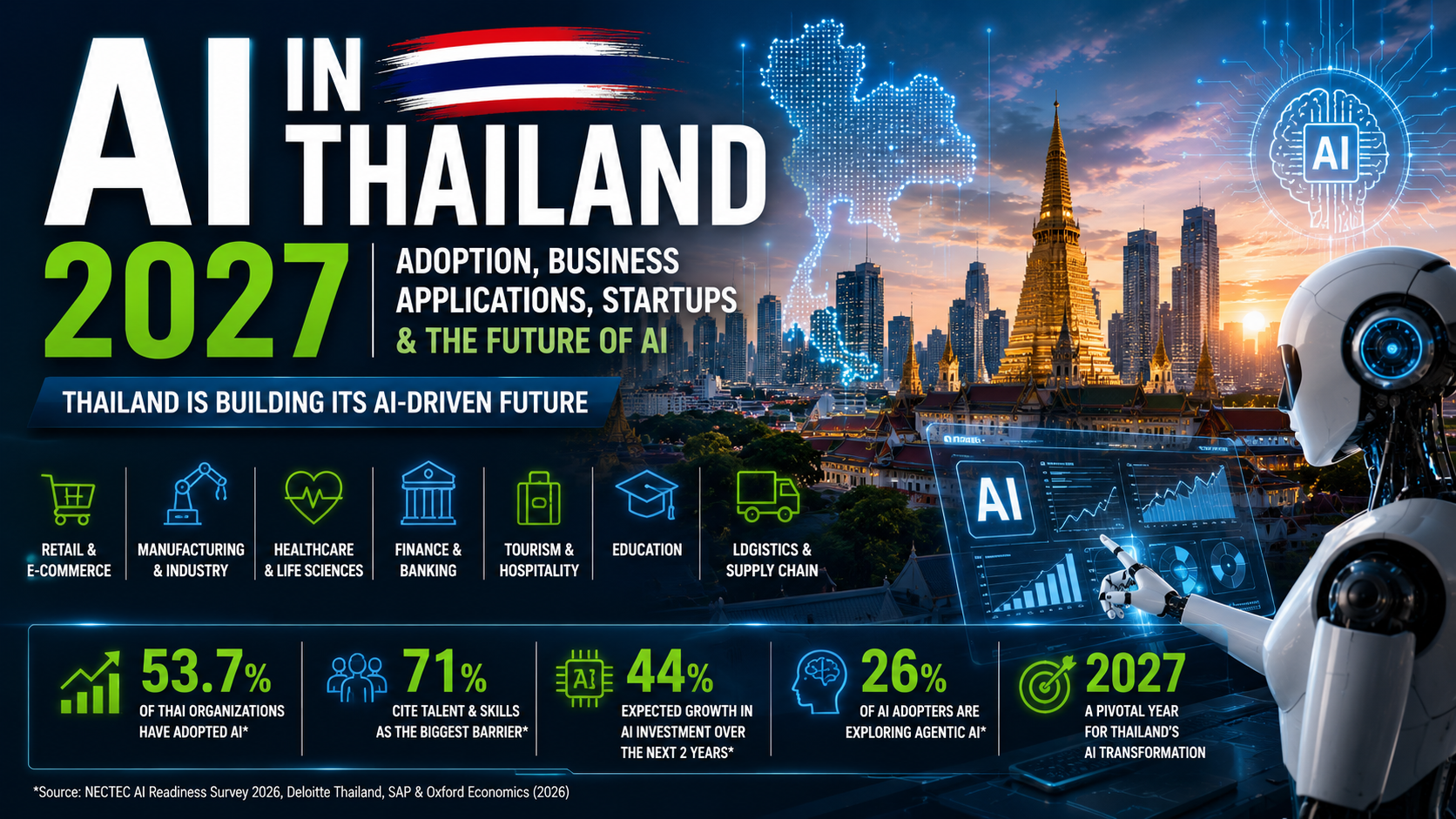
Thailand's 2026 Organization AI Readiness Survey, conducted by the National Science and Technology Development Agency (NSTDA) through NECTEC, found that 53.7% of surveyed Thai organizations had already adopted AI, while another 36.6% planned to use it. The survey covered 574 public- and private-sector organizations across 10 industry groups.
Deloitte's 2026 Thailand Digital Transformation Survey reported an even higher figure, with 61% of surveyed Thai organizations implementing AI. However, only 19% had successfully scaled AI across their organizations, while 81% remained in experimentation or pilot stages.
The difference between the two figures reflects different surveys and methodologies, but both point toward the same conclusion:
AI adoption in Thailand is accelerating, while large-scale implementation remains a major opportunity.
With Thailand's national AI strategy running through 2027, the coming year could be particularly important for the country's AI ecosystem.
AI in Thailand: 2027 Overview
Thailand is developing an AI ecosystem involving:
Large enterprises
SMEs
Government organizations
Universities
Research institutions
Technology companies
AI startups
Cloud providers
Data-centre operators
AI researchers
Digital-service companies
AI adoption is also becoming increasingly diverse.
Businesses are using AI for:
Customer service
Marketing
Sales
Data analysis
Product development
Research and development
Business strategy
Automation
Fraud detection
Forecasting
Document processing
Software development
The challenge is now moving from "Should we use AI?" to "How can we use AI effectively and responsibly at scale?"
How Fast Is AI Adoption Growing in Thailand?
Thailand's AI adoption has increased substantially over the past several years.
NECTEC's 2026 survey found that the proportion of organizations adopting AI had tripled between 2024 and 2026.
Among the 574 organizations surveyed:
53.7% had already adopted AI
36.6% planned to use AI
9.8% had no current plans to use AI
Large organizations had the highest adoption rate at 67.2%, compared with 48.5% for medium-sized organizations and 43.8% for small organizations.
This indicates that AI is moving beyond a technology used only by Thailand's largest corporations.
SMEs are increasingly becoming part of the country's AI adoption story as well.
Why Are Thai Businesses Investing in AI?
Thai organizations are pursuing AI for several reasons.
Productivity
AI can automate repetitive work and help employees process information more quickly.
Cost reduction
AI can reduce the time required for certain administrative and operational tasks.
Customer experience
AI-powered chatbots, recommendation systems and customer-service tools can improve interactions.
Data analysis
Businesses can use AI to identify patterns across large datasets.
Product development
AI can support research, design, testing and innovation.
Competitive advantage
Organizations increasingly view AI capabilities as a way to differentiate themselves.
Deloitte found that 50% of surveyed Thai businesses said AI had reduced costs, while 48% reported improved efficiency and productivity.
However, only 9% said AI had helped unlock new revenue, demonstrating that Thailand's AI opportunity is still largely focused on efficiency rather than transformational growth.
Generative AI in Thailand
Generative AI is currently one of the most accessible forms of artificial intelligence for Thai organizations.
Businesses can use generative AI to create:
Text
Marketing content
Images
Presentations
Software code
Reports
Customer responses
Summaries
Research documents
NECTEC's 2026 survey found that among organizations already using AI, generative AI was particularly common in marketing, sales and customer service, where 74.7% of AI-using organizations reported usage.
It was also widely used in:
Corporate strategy — 69.8%
Product/service development and R&D — 68.8%
This suggests that generative AI is moving quickly from experimentation into everyday business workflows.
Agentic AI in Thailand
The next stage of AI adoption could involve systems that do more than generate content.
Agentic AI can pursue goals, plan tasks, make decisions and execute multi-step workflows with varying levels of human oversight.
Thailand is still at an early stage of agentic AI adoption.
NECTEC reported that 26% of organizations already using AI had begun using agentic AI. The highest levels of use were found in product development/R&D, corporate strategy, and marketing, sales and customer service.
SAP and Oxford Economics also found that 78% of Thai businesses surveyed saw moderate to very high potential for agentic AI to transform their organizations.
This creates an important opportunity for Thai companies in 2027.
AI in Thai Businesses
Enterprise AI is likely to become one of the biggest areas of growth.
Businesses can use AI across the entire organization.
AI in Marketing
AI can help companies with:
Content creation
Customer segmentation
Campaign optimization
Personalization
Market research
Advertising analysis
AI in Customer Service
AI assistants can help companies:
Answer customer questions
Provide 24/7 support
Summarize conversations
Route customer requests
Analyze customer sentiment
AI in Finance
Potential applications include:
Fraud detection
Risk assessment
Financial forecasting
Document processing
Customer analysis
Compliance
AI in Manufacturing
Manufacturers can use AI for:
Predictive maintenance
Quality inspection
Computer vision
Production optimization
Demand forecasting
Robotics
NECTEC's survey found that manufacturing recorded the highest level of AI use among the industry groups studied.
AI in Healthcare in Thailand
Healthcare is another major opportunity for AI.
Potential applications include:
Medical imaging
Clinical decision support
Patient monitoring
Drug research
Hospital administration
Medical data analysis
Personalized healthcare
Thailand's national AI strategy identifies healthcare as an important application area and includes initiatives such as a Medical AI Data Sharing Platform.
The country's AI ecosystem could therefore support both healthcare innovation and improvements in healthcare delivery.
AI in Thailand's Financial Sector
Thailand's financial industry is one of the sectors where AI readiness can be particularly important.
Applications include:
Fraud detection
Credit analysis
Customer service
Financial forecasting
Risk management
Anti-money-laundering systems
Personalized financial products
NECTEC's 2026 research found that banks had an average AI-readiness score of 70.7%, making banking the only group in the survey to reach its "Ready" category. The survey also reported an 81.2% governance score for banks.
This demonstrates how strong data practices and regulatory structures can support AI adoption.
AI in Thailand's Manufacturing Industry
Manufacturing is especially important to Thailand's AI future because the country has a large industrial and automotive base.
AI can be used to improve:
Factory automation
Quality control
Predictive maintenance
Production planning
Supply-chain management
Robotics
Computer vision
Energy efficiency
Computer vision is already identified as an AI application within Thailand's national AI initiatives, including machine-vision applications for manufacturing.
As Thailand moves toward smart factories and Industry 4.0, AI is likely to become increasingly connected with robotics, IoT and industrial automation.
AI in Thailand's Tourism Industry
Tourism represents another major opportunity.
AI can support:
Personalized travel recommendations
Multilingual customer service
Hotel management
Demand forecasting
Dynamic pricing
Destination marketing
Travel planning
Tourism analytics
Thailand's national AI strategy includes initiatives designed to use data and AI to strengthen tourism potential, including the Travel Link project.
This creates opportunities for tourism companies, hotels, airlines, travel platforms and destination-management organizations.
AI in Education in Thailand
AI is also changing education.
Potential applications include:
Personalized learning
AI tutoring
Automated assessment
Language learning
Teacher assistance
Educational content creation
Student analytics
Thailand's national AI strategy includes AI education and workforce development across multiple levels, including AI literacy, universities and lifelong learning.
Developing AI skills will be particularly important as businesses increasingly require employees who understand how to work with AI systems.
AI Startups in Thailand
Thailand's AI ecosystem is also creating opportunities for startups.
AI startups can develop solutions in areas such as:
Generative AI
Enterprise software
Financial technology
Healthcare
Retail
Logistics
Manufacturing
Tourism
Education
Computer vision
Robotics
The national AI strategy specifically identifies AI innovation for technology startups, SMEs and digital businesses as part of its economic-growth objectives.
The opportunity for startups is not necessarily to compete directly with global foundation-model companies.
Instead, many Thai startups can create value by developing localized AI applications, Thai-language solutions, industry-specific tools and AI-powered business services.
Thai-Language AI and Localized AI Models
Language is an important consideration for AI adoption in Thailand.
AI systems designed primarily around English-language data may not always provide the same level of performance for Thai-language applications.
Thailand's national AI strategy includes the development of Thai LLM capabilities supporting the Thai language.
Localized AI can create opportunities in:
Thai-language customer service
Government services
Education
Healthcare
Legal technology
Business communications
Search
Voice assistants
The development of Thai-language AI could become an important part of Thailand's digital sovereignty and AI ecosystem.
Thailand's National AI Strategy 2022–2027
Thailand has been implementing a National AI Strategy and Action Plan for 2022–2027.
Its vision is to establish an effective ecosystem for AI development and application that supports the economy and quality of life by 2027.
The strategy focuses on areas including:
Human capacity and technology
Economic growth
Social and environmental impact
AI infrastructure
AI education
AI innovation
Public-sector applications
Responsible AI development
The strategy also includes AI workforce development and initiatives targeting AI skills across different levels.
This makes 2027 a particularly relevant year for evaluating Thailand's progress toward its national AI ambitions.
AI Workforce Development in Thailand
AI adoption cannot scale without people who understand how to use and develop AI.
Thailand therefore faces a significant workforce challenge.
Deloitte reported that 71% of surveyed Thai organizations identified a lack of technical talent and skills as a major barrier to AI adoption.
Thailand's AI programs are consequently focusing on:
AI literacy
Upskilling
Reskilling
AI engineering
AI research
AI development
Executive education
The national AI strategy includes a workforce-development program covering multiple levels, from basic AI literacy to AI professionals.
For companies, this means AI skills are likely to become an increasingly important hiring and training priority.
The Biggest Challenge: Scaling AI
Thailand's AI challenge is no longer simply adoption.
It is scaling.
Deloitte found that only 19% of surveyed Thai organizations had successfully scaled AI across their operations, while 81% remained in experimentation or pilot stages.
NECTEC found a similar challenge from a different perspective.
Among organizations already using AI, 86.4% could not yet clearly state what results they had achieved. Only 13.6% had measured results and found clear positive outcomes.
This means businesses need to become better at answering:
What problem is AI solving?
How much value is it creating?
How should success be measured?
What risks does the system introduce?
Can the solution scale across the organization?
AI Governance in Thailand
Responsible AI will become increasingly important as adoption expands.
Organizations need to consider:
Data privacy
Security
Bias
Accuracy
Transparency
Human oversight
Intellectual property
AI-generated content
Model risks
Regulatory compliance
NECTEC's 2026 survey found governance was the weakest AI-readiness dimension, scoring only 28.9%.
This is particularly important as generative and agentic AI become more powerful.
Thailand's national AI strategy also includes preparation around social, ethical, legal and regulatory issues related to AI.
AI Investment in Thailand
Investment is likely to increase as organizations move from experimentation toward enterprise-scale AI.
SAP and Oxford Economics reported that the average Thai company in their study expected to spend approximately US$18.3 million on AI in 2026, with AI investment expected to grow by 44% over the following two years.
The same study found that Thai businesses expected average AI ROI to rise from approximately 18% in 2026 to 35% in two years.
These figures suggest that businesses increasingly see AI as an investment rather than simply an experimental technology.
What Will Drive AI Growth in Thailand in 2027?
Several factors could accelerate adoption.
1. Generative AI
Easy-to-use AI tools will continue to lower the barrier to adoption.
2. Agentic AI
AI systems capable of completing multi-step workflows could increase automation.
3. Cloud and AI infrastructure
Better access to compute and cloud platforms will make advanced AI more accessible.
4. Thai-language AI
Localized models can improve AI's usefulness for Thai users.
5. AI workforce development
More trained workers can help organizations move beyond experimentation.
6. Government support
National AI programs can encourage adoption and investment.
7. Enterprise demand
Companies will increasingly seek measurable productivity and revenue improvements from AI.
AI in Thailand 2027: Key Challenges
Despite the strong growth outlook, several challenges remain.
Talent shortages
Companies need more AI engineers, data specialists and employees with practical AI skills.
Data quality
AI systems require reliable and well-structured data.
AI infrastructure
Organizations need sufficient computing, cloud and data infrastructure.
Governance
Businesses need practical policies for managing AI risk.
ROI measurement
Organizations must demonstrate measurable business outcomes.
Cybersecurity
AI systems create new security and data-protection considerations.
SME adoption
Smaller organizations may have fewer resources for AI investment and specialized talent.
These challenges represent both obstacles and opportunities for Thailand's AI ecosystem.
What to Expect From AI in Thailand in 2027
2027 could be a transition year for Thailand's AI ecosystem.
The market is likely to move from:
AI awareness → AI experimentation → AI implementation → AI scaling
Generative AI will remain important, but enterprise AI and agentic AI could increasingly become the focus.
Businesses are likely to concentrate on practical applications that can demonstrate measurable outcomes.
We can expect increasing interest in:
AI agents
Thai-language AI
Enterprise AI
AI automation
AI-powered customer service
AI in manufacturing
AI in finance
AI in healthcare
AI infrastructure
AI governance
AI workforce development
Thailand AI Market: Key Statistics
Indicator | Latest reported figure |
|---|---|
Thai organizations adopting AI — NECTEC 2026 | 53.7% |
Organizations planning to use AI | 36.6% |
AI adoption — Deloitte 2026 | 61% |
Organizations that scaled AI — Deloitte | 19% |
Organizations still in pilots/experimentation | 81% |
AI users adopting Agentic AI — NECTEC | 26% |
Thai organizations citing talent/skills as a barrier | 71% |
Organizations unable to clearly measure AI results — NECTEC | 86.4% |
Thai businesses expecting AI investment growth over two years — SAP/Oxford Economics | 44% |
These figures come from different surveys and should not be treated as a single unified dataset. Together, however, they show the same broad trend: AI adoption is accelerating in Thailand, while scaling, governance, skills and measurable ROI remain major challenges.
Is Thailand Ready for an AI-Driven Economy?
Thailand has made significant progress toward building an AI ecosystem.
The country has:
A national AI strategy
Growing enterprise adoption
AI startups
Universities and research institutions
AI workforce programs
Growing investment
Government AI initiatives
Increasing use of generative AI
Early adoption of agentic AI
However, readiness is not yet uniform.
NECTEC's 2026 survey gave AI-using organizations an average readiness score of 40%, categorized as "AI Aware." Governance scored particularly low at 28.9%, while technology readiness was 32.2%.
The next challenge is therefore not simply getting more organizations to use AI.
It is helping organizations use AI effectively, safely and at scale.
Why Thailand Could Become an Important AI Hub in Southeast Asia
Thailand has several characteristics that could support the development of a stronger AI ecosystem.
These include:
A large domestic market
Established manufacturing industries
Strong financial institutions
Growing digital services
Tourism
Healthcare
Automotive and electronics sectors
Universities and research institutions
Government AI initiatives
Growing technology investment
AI could therefore become an important layer across multiple parts of the Thai economy.
Rather than being limited to technology companies, AI has the potential to become embedded in manufacturing, finance, healthcare, tourism, retail, logistics, education and government services.
Why AI Conferences in Thailand Matter
As Thailand's AI ecosystem develops, conferences and industry events can provide an important platform for connecting:
AI researchers
Business leaders
Technology companies
Startups
Investors
Government representatives
Developers
AI practitioners
Academics
For organizations looking to understand where Thailand's AI ecosystem is heading, these events can provide opportunities to discuss emerging technologies, business applications, responsible AI and future investment.
This is where Global SI Conference can become part of the conversation.
You can naturally link this article to your AI Conferences in Thailand 2027 article and your Global SI Conference event page.
The Future of AI in Thailand
Thailand's AI journey is entering a new stage.
The first phase was about understanding artificial intelligence.
The next phase was about experimenting with generative AI.
The next stage is likely to be about enterprise implementation, automation, AI agents and measurable business value.
For Thai organizations, success will increasingly depend on five foundations:
People + Data + Technology + Governance + Strategy
Organizations that develop all five will be better positioned to move from AI experimentation to meaningful business transformation.
Frequently Asked Questions
Is AI growing in Thailand?
Yes. NECTEC's 2026 survey found that 53.7% of surveyed Thai organizations had already adopted AI, while Deloitte reported 61% of surveyed organizations implementing AI.
What is the outlook for AI in Thailand in 2027?
AI adoption is expected to continue expanding, particularly in enterprise applications, generative AI, automation and emerging agentic AI. Thailand's National AI Strategy and Action Plan runs through 2027.
Which industries are using AI in Thailand?
AI is being used across manufacturing, finance, healthcare, education, marketing, sales, customer service, product development and other sectors. NECTEC's survey identified manufacturing as having the highest AI usage among the industry groups it studied.
How common is generative AI in Thailand?
Generative AI is already widely used among Thai organizations that have adopted AI, particularly in marketing, sales, customer service, corporate strategy and product development/R&D.
Is Thailand using Agentic AI?
Yes, although adoption is still relatively early. NECTEC reported that 26% of organizations already using AI had begun using agentic AI.
What are the biggest barriers to AI adoption in Thailand?
Major challenges include a shortage of technical skills, difficulty identifying valuable use cases, data readiness, infrastructure and governance. Deloitte reported that 71% of surveyed organizations cited talent and skills as a major barrier.
Does Thailand have a national AI strategy?
Yes. Thailand's National AI Strategy and Action Plan covers 2022–2027 and focuses on human capacity, technology, economic growth and social and environmental impact.
Is Thailand becoming an AI hub in Southeast Asia?
Thailand is developing many of the foundations required for a stronger regional AI ecosystem, including enterprise adoption, AI research, workforce development, infrastructure and government initiatives. Its future position will depend on how effectively these capabilities are scaled.
Conclusion
AI in Thailand in 2027 is likely to be defined by a shift from experimentation to implementation.
More Thai organizations are adopting artificial intelligence, while businesses are increasingly exploring generative AI and agentic AI. At the same time, the country's national AI strategy is approaching its 2027 horizon.
The biggest opportunity is no longer simply introducing AI tools.
It is building organizations that can use AI to create measurable productivity, business and social value.
Thailand has already developed a strong foundation through government programs, technology companies, startups, universities and increasingly AI-enabled enterprises.
The next question is how quickly Thai organizations can overcome challenges around talent, data, infrastructure, governance and ROI measurement.
If they can, Thailand could become an increasingly important AI and digital innovation hub in Southeast Asia.