
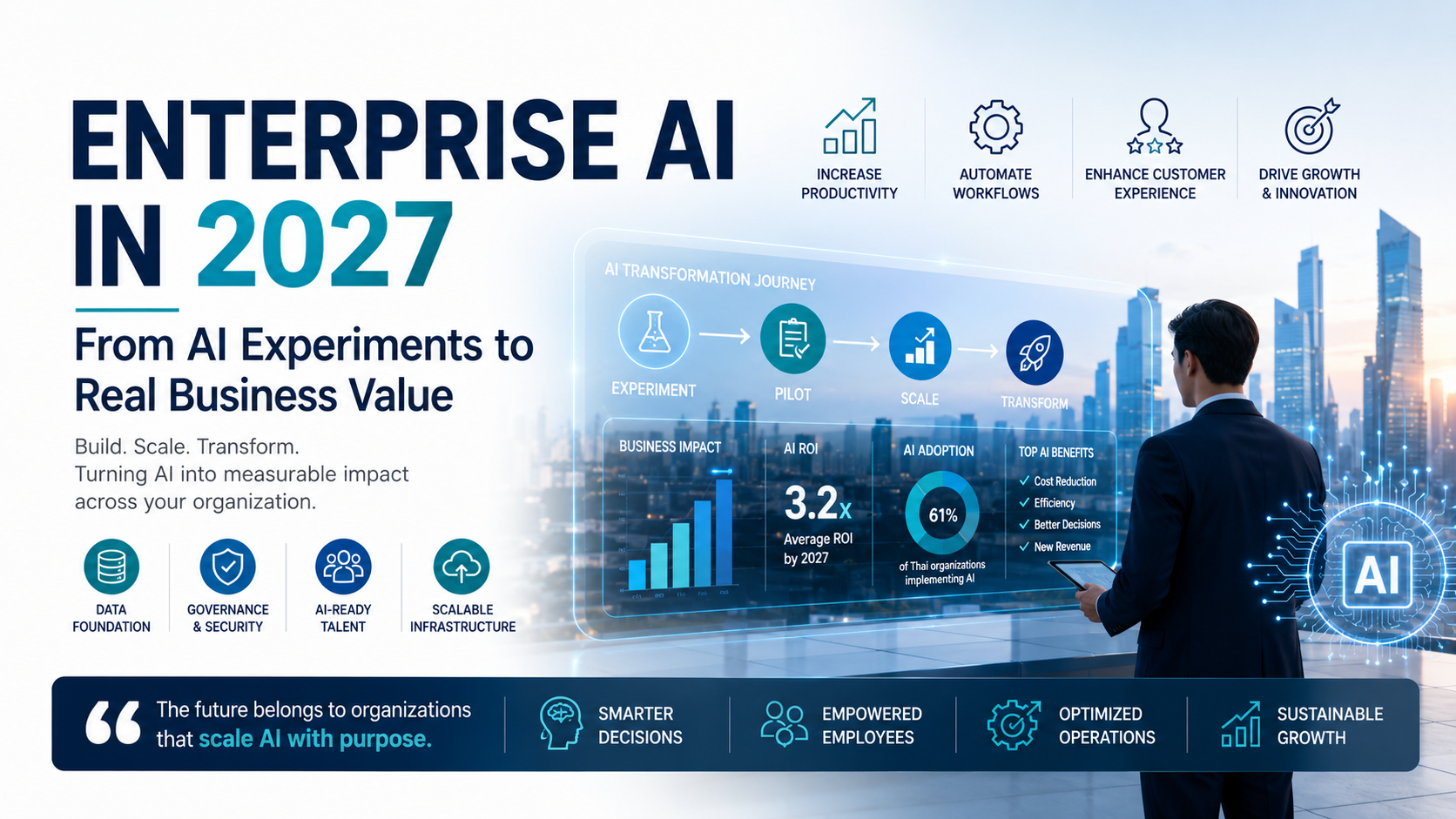
Enterprise AI in 2027: From AI Experiments to Real Business Value
Artificial intelligence has moved from being an emerging technology to becoming a strategic business priority.
Organizations across industries are experimenting with generative AI, machine learning, automation and AI agents to improve productivity, reduce costs and create new products and services.
But there is a major difference between using AI and creating business value from AI.
Many companies have launched AI pilots, purchased AI software or introduced generative AI tools to employees. Yet only a smaller proportion have successfully integrated AI across their operations.
This gap between AI experimentation and enterprise-scale implementation will be one of the defining business challenges of 2027.
In Thailand, the situation is particularly interesting. Deloitte's 2026 Thailand Digital Transformation Survey found that 61% of Thai organizations were implementing AI, but only 19% had scaled AI across their operations, while 81% remained in experimentation or pilot stages.
The next stage of enterprise AI will therefore not simply be about adopting more AI tools.
It will be about connecting AI with people, data, processes, technology and business strategy.
What Is Enterprise AI?
Enterprise AI refers to the use of artificial intelligence across an organization's business functions, operations, products and decision-making processes.
Instead of using AI for one isolated task, enterprise AI aims to integrate artificial intelligence into the broader organization.
Enterprise AI can include:
Generative AI
Machine learning
Predictive analytics
AI-powered automation
Computer vision
Natural language processing
AI copilots
Agentic AI
Intelligent search
Recommendation systems
AI-powered customer service
AI-driven decision support
The important word is enterprise.
Enterprise AI is not simply about giving employees access to a chatbot.
It is about redesigning how an organization works around intelligent technologies.
Why Enterprise AI Will Matter in 2027
The AI market is entering a new phase.
During the early stages of AI adoption, businesses often focused on experimentation.
Employees tested chatbots.
Marketing teams generated content.
Developers used AI coding assistants.
Customer-service teams experimented with AI responses.
Executives explored potential use cases.
The next phase is different.
Businesses increasingly want to know:
What value did AI actually create?
This is becoming especially important in Thailand.
NECTEC's 2026 Organization AI Readiness Survey found that 53.7% of surveyed Thai organizations had already adopted AI, while another 36.6% planned to use it. However, among organizations already using AI, only 13.6% had measured results and found clear positive outcomes.
This creates a major opportunity.
Companies that can move from experimentation to measurable outcomes could gain a significant competitive advantage.
Enterprise AI in Thailand: The Current Situation
Thailand is entering an important stage of enterprise AI development.
Deloitte found that AI implementation among Thai organizations had risen to 61% in 2026, up from 47% the previous year. However, only 19% had scaled AI across their operations.
The research also identified several barriers:
71% cited technical talent and skills as a major challenge.
40% struggled to identify AI use cases.
38% reported data-readiness issues.
38% identified AI infrastructure security as a challenge.
At the same time, businesses are already seeing benefits.
Half of surveyed organizations reported cost reductions from AI, while 48% reported improvements in efficiency and productivity. Only 9% reported that AI had unlocked new revenue.
This suggests that Thailand's first wave of enterprise AI is primarily focused on efficiency.
The next opportunity is using AI for growth and transformation.
From AI Experiments to Enterprise AI
The transition from experimentation to enterprise AI can be understood in several stages.
Stage 1: AI Awareness
Employees and executives begin learning about AI.
Typical activities include:
AI demonstrations
Training sessions
Chatbot experimentation
Generative AI trials
Stage 2: AI Pilots
Businesses begin testing specific use cases.
Examples include:
Marketing content generation
Customer-service chatbots
AI-assisted coding
Document analysis
Forecasting
Stage 3: AI Production
Successful pilots are deployed into real business processes.
AI becomes part of everyday workflows.
Stage 4: AI Scaling
Multiple departments begin using AI.
Organizations establish:
Shared infrastructure
Governance
AI policies
Data platforms
AI teams
Measurement frameworks
Stage 5: AI Transformation
At the highest level, AI changes how the organization operates.
Business processes are redesigned around human-AI collaboration.
Products and services may change.
New revenue models can emerge.
This is where enterprise AI can create its greatest value.
The Biggest Enterprise AI Opportunity: Workflow Transformation
One of the biggest mistakes companies make is treating AI as another software application.
The real opportunity is often workflow transformation.
Imagine a customer-service process.
Traditional workflow:
Customer → Human Agent → Search Information → Prepare Response → Customer
AI-assisted workflow:
Customer → AI Assistant → Retrieve Information → Draft Response → Human Review → Customer
A more advanced agentic workflow could potentially become:
Customer → AI Agent → Understand Request → Retrieve Information → Execute Approved Actions → Escalate When Necessary
The technology is only part of the transformation.
The organization must also redesign the process around it.
Deloitte similarly emphasizes that businesses need to redesign workflows so humans and AI complement each other's strengths rather than simply adding AI to existing processes.
Enterprise AI and Generative AI
Generative AI is likely to remain one of the most important components of enterprise AI in 2027.
Businesses can use generative AI for:
Marketing
Content creation
Campaign ideas
Personalization
Market research
Social media
Sales
Lead research
Proposal generation
Sales summaries
Customer insights
Customer Service
Response generation
Knowledge retrieval
Call summaries
Customer sentiment analysis
Human Resources
Job descriptions
Employee support
Training materials
Internal knowledge
Software Development
Code generation
Testing
Documentation
Debugging assistance
Finance
Report analysis
Document processing
Financial summaries
Forecasting assistance
The biggest opportunity is not simply generating content faster.
It is connecting generative AI to enterprise data and workflows.
Enterprise AI and Agentic AI
The next evolution of enterprise AI is increasingly connected to agentic AI.
An AI assistant may answer a question.
An AI agent can potentially perform a series of tasks toward a goal.
For example:
"Analyze this month's sales performance and prepare a report."
A traditional AI system might generate a report from provided data.
An agentic system could potentially:
Retrieve approved data.
Analyze sales performance.
Compare results with previous periods.
Identify anomalies.
Generate insights.
Create a report.
Send it to an authorized manager.
This could dramatically change enterprise workflows.
However, autonomy also introduces additional governance requirements.
NECTEC's 2026 survey found that 26% of AI-using Thai organizations had begun using agentic AI, with usage particularly visible in product development/R&D, corporate strategy and marketing, sales and customer service.
AI Investment Is Increasing
Enterprise AI is also becoming a significant investment category.
Research from SAP and Oxford Economics found that the average Thai company expected to spend approximately US$18.3 million on AI in 2026, with AI investment expected to increase by 44% over the following two years. The research also projected average AI ROI to rise from 18% to 35% over that period.
This demonstrates why enterprise AI strategy is becoming increasingly important.
Companies are not simply spending money on AI tools.
They are increasingly looking at AI as a strategic investment.
But higher investment does not automatically produce higher returns.
The key question is:
Where should businesses invest?
How Businesses Can Identify High-Value AI Use Cases
One of the biggest barriers to AI adoption is identifying the right use cases.
Deloitte found that 40% of Thai organizations identified difficulty identifying AI use cases as a challenge.
A useful approach is to evaluate business processes according to five criteria.
1. Business Impact
Could AI significantly improve the outcome?
2. Frequency
Does the task happen frequently?
3. Data Availability
Is there enough reliable data?
4. Feasibility
Can AI realistically perform the task?
5. Risk
What happens if AI makes a mistake?
High-value, low-risk use cases should generally be strong candidates for early deployment.
Enterprise AI ROI: How Should Businesses Measure Success?
AI ROI cannot be measured only by the number of employees using an AI tool.
Organizations should establish specific KPIs.
Productivity
Hours saved
Tasks completed
Processing time
Employee output
Cost
Cost per transaction
Operational expenses
Automation savings
Customer Experience
Response time
Customer satisfaction
Resolution rates
Retention
Revenue
Conversion rate
New revenue
Upselling
Cross-selling
Quality
Error reduction
Accuracy
Defect rates
Innovation
New products
New services
New business models
The goal is to connect AI activity to business outcomes.
Data Is the Foundation of Enterprise AI
AI systems are only as useful as the information they can access.
This makes data infrastructure one of the most important components of enterprise AI.
Organizations need:
Clean data
Accessible data
Secure data
Well-managed data
Consistent data
Appropriate data governance
NECTEC's 2026 survey found that although 64% of surveyed organizations had data-storage systems, only 40.8% had data quality considered ready for AI use. More than half, 51.6%, lacked an AI architecture capable of supporting integration and scale.
This highlights an important lesson:
Buying an AI model is easier than preparing an organization to use it effectively.
Enterprise AI and Cloud Infrastructure
Large-scale AI applications require computing infrastructure.
Businesses may use:
Cloud AI platforms
GPUs
AI accelerators
Data platforms
Model APIs
Vector databases
AI orchestration platforms
Edge computing
The right infrastructure depends on the use case.
Not every company needs to build its own large AI model.
For many businesses, the most practical approach may be to combine external AI models with proprietary company data, secure APIs and internal applications.
AI Talent and the Future Workforce
Enterprise AI requires more than data scientists.
Organizations need people who understand how AI connects to business operations.
Important skills include:
AI literacy
Data analysis
Prompt engineering
AI product management
Machine learning
Cybersecurity
AI governance
Process redesign
Change management
Deloitte found that 71% of Thai organizations identified technical talent and skills as a major barrier to AI adoption.
This means workforce development will be critical to Thailand's enterprise AI growth.
AI Is Becoming a Cross-Functional Business Issue
One of the biggest organizational changes in 2027 will be moving AI beyond the IT department.
AI affects:
Marketing
Finance
HR
Operations
Sales
Customer service
Product development
Legal
Risk
Strategy
Deloitte found that nearly 70% of Thai organizations still viewed AI primarily as an IT responsibility.
That approach may become increasingly limiting.
Enterprise AI needs business ownership.
IT should provide the technical infrastructure and security.
But business leaders should determine where AI creates value.
Enterprise AI Governance
Scaling AI without governance can create significant risks.
Enterprise AI governance should address:
Data privacy
Cybersecurity
Model risk
AI accuracy
Bias
Intellectual property
Human oversight
Vendor management
AI accountability
Monitoring
Governance should not prevent innovation.
Instead, good governance should help companies deploy AI safely and repeatedly.
This is particularly important as organizations begin using autonomous AI agents.
SAP and Oxford Economics found that only 2% of surveyed Thai businesses said they were fully prepared for agentic AI, while many lacked processes such as human-in-the-loop controls, agent approval procedures and agent registries.
Enterprise AI Security
AI creates new cybersecurity considerations.
Businesses need to protect:
AI models
Training data
Customer information
Internal documents
API credentials
AI agents
Enterprise knowledge bases
Organizations should also consider risks such as:
Prompt injection
Data leakage
Unauthorized access
Malicious AI inputs
Model manipulation
Third-party AI vulnerabilities
AI security should therefore become part of the broader cybersecurity strategy.
Enterprise AI and Human-AI Collaboration
The future of enterprise AI is unlikely to be purely human or purely machine.
It will increasingly involve collaboration.
Humans provide:
Context
Judgment
Creativity
Leadership
Empathy
Accountability
AI provides:
Speed
Scale
Pattern recognition
Automation
Information processing
Continuous availability
The organizations that combine these strengths effectively may gain the greatest advantage.
Enterprise AI in Manufacturing
Manufacturing is one of the sectors with significant potential for enterprise AI.
Applications include:
Predictive maintenance
Quality control
Demand forecasting
Production optimization
Computer vision
Supply-chain planning
Digital twins
Robotics
Thailand's manufacturing sector already records high AI usage compared with other sectors in the NECTEC survey, making it an important area for enterprise AI development.
Enterprise AI in Finance
Financial organizations have significant opportunities to use AI for:
Fraud detection
Risk analysis
Customer service
Credit assessment
Financial forecasting
Compliance
Document processing
The NECTEC survey found particularly strong AI readiness among Thai banks, with banks recording a 70.7% average readiness score and 81.2% governance readiness.
Enterprise AI in Healthcare
Healthcare organizations can use AI for:
Medical imaging
Administrative automation
Research
Patient support
Drug discovery
Hospital operations
Clinical decision support
However, healthcare AI requires strong governance because errors can directly affect patient outcomes.
Enterprise AI in Retail and Customer Service
Retailers can use AI to personalize customer experiences.
Applications include:
Product recommendations
Demand forecasting
Inventory optimization
Customer-service automation
Marketing personalization
Dynamic pricing
Customer analytics
Generative AI is already particularly common in marketing, sales and customer service among Thai organizations using AI. NECTEC found 74.7% of AI-using organizations using GenAI in those areas.
Enterprise AI in 2027: From Efficiency to Growth
The first generation of enterprise AI has largely focused on efficiency.
Companies want to:
Reduce costs
Automate repetitive work
Increase productivity
Improve customer service
But the next opportunity is growth.
AI could help businesses:
Launch new products
Personalize services
Discover new markets
Build AI-powered products
Create new revenue models
Improve customer retention
This is important because Deloitte found that while half of surveyed Thai businesses reported cost reductions from AI, only 9% reported unlocking new revenue.
The next phase of enterprise AI should therefore move beyond:
"How much money can AI save?"
toward:
"How can AI help us create new value?"
The Autonomous Enterprise
A longer-term direction for enterprise AI is the autonomous enterprise.
In this model, AI becomes deeply embedded across business operations.
AI systems could potentially:
Monitor operations
Detect problems
Recommend actions
Execute approved workflows
Communicate with customers
Coordinate supply chains
Analyze financial information
Support employees
Humans would remain responsible for strategic decisions, governance and oversight while AI handles increasing amounts of operational work.
SAP and Oxford Economics describe this direction as connecting AI with data, processes and governance to create what they call an "Autonomous Enterprise."
How Businesses Can Prepare for Enterprise AI in 2027
Companies preparing for the next stage of AI should consider six priorities.
1. Build an AI Strategy
Define what the organization wants AI to achieve.
2. Identify High-Value Use Cases
Focus on business problems rather than technology trends.
3. Improve Data Foundations
Make data accessible, reliable and secure.
4. Develop AI Skills
Train employees across technical and non-technical functions.
5. Establish Governance
Create policies for responsible AI use.
6. Measure Business Outcomes
Connect AI projects to measurable KPIs.
These six areas provide a foundation for moving from experimentation toward enterprise-scale value.
Enterprise AI Trends to Watch in 2027
Several trends are likely to shape enterprise AI.
AI Agents
More businesses will experiment with autonomous workflows.
AI Copilots
AI assistants will become embedded into business software.
Multimodal AI
Organizations will use AI across text, images, audio and video.
AI-Powered Decision Making
AI will increasingly support complex business decisions.
Industry-Specific AI
Businesses will use specialized AI models for specific industries.
AI Governance
Organizations will establish stronger policies and monitoring.
AI Infrastructure
Investment in data, computing and AI platforms will continue.
Human-AI Collaboration
Workflows will increasingly be redesigned around humans and intelligent systems.
What Will Separate AI Leaders from AI Followers?
By 2027, simply having an AI strategy will not be enough.
Leading organizations will likely have several characteristics in common.
They will:
Start with business problems
Have strong data foundations
Measure AI ROI
Invest in employee skills
Redesign workflows
Integrate AI across departments
Establish governance early
Treat AI as a business capability
Build reusable AI infrastructure
Continuously evaluate results
AI maturity will therefore be measured less by how many AI tools a company owns and more by how effectively it turns AI into measurable outcomes.
Why Enterprise AI Matters for Thailand
Thailand has an opportunity to accelerate its transition toward an AI-driven economy.
The country has important strengths across:
Manufacturing
Automotive
Electronics
Finance
Tourism
Healthcare
Logistics
Retail
Digital services
Enterprise AI can help these industries improve productivity and develop new capabilities.
However, the country's next challenge is scaling.
NECTEC's 2026 assessment concluded that Thailand's challenge is no longer simply encouraging organizations to start using AI, but helping them select appropriate use cases, prepare data and talent, measure results and establish governance so AI can create real value.
That makes 2027 an important year for enterprise AI in Thailand.
Why AI Conferences Matter for Enterprise AI
Enterprise AI requires collaboration between many different groups.
Business leaders need to understand emerging technologies.
Technology teams need to understand business priorities.
Policymakers need to understand industry challenges.
Startups need access to customers and investors.
Researchers need opportunities to translate innovation into practical applications.
AI conferences can bring these communities together.
For organizations exploring enterprise AI, events such as Global SI Conference can provide an environment to discuss AI strategy, generative AI, agentic AI, governance, enterprise transformation and emerging technologies.
As companies move from AI experimentation toward large-scale deployment, these conversations will become increasingly important.
Enterprise AI in 2027: Key Takeaways
Enterprise AI is moving beyond experimentation.
Businesses increasingly need measurable AI ROI.
AI adoption alone does not guarantee business value.
Workflow redesign is essential for enterprise-scale AI.
Data quality remains a major foundation for AI success.
AI talent and skills will remain critical.
Generative AI will continue expanding across business functions.
Agentic AI will create new opportunities and governance challenges.
AI must become a cross-functional business priority rather than only an IT initiative.
The next stage of AI will focus increasingly on revenue, innovation and business transformation.
Thailand has rapidly increasing AI adoption but still faces challenges in scaling AI.
Companies that successfully combine AI + data + people + processes + governance will be better positioned to create sustainable value.
FAQs
What is Enterprise AI?
Enterprise AI is the use of artificial intelligence across an organization's business functions, operations, products and decision-making processes.
Why is Enterprise AI important in 2027?
AI adoption is moving from experimentation toward enterprise-wide implementation. Businesses increasingly need to integrate AI into workflows and measure its impact on productivity, costs, customer experience and revenue.
What is the difference between AI adoption and Enterprise AI?
AI adoption can involve using individual AI tools or running pilot projects. Enterprise AI involves integrating AI strategically across multiple business functions and processes.
How can businesses measure AI ROI?
Businesses can measure AI ROI using metrics such as productivity improvements, cost savings, revenue growth, customer satisfaction, processing time, quality improvements and new business opportunities.
What is the biggest challenge for Enterprise AI?
Common challenges include data quality, AI skills, identifying valuable use cases, governance, cybersecurity, infrastructure and organizational change.
How is Thailand adopting Enterprise AI?
AI adoption is growing rapidly in Thailand. Deloitte reported that 61% of Thai organizations were implementing AI in 2026, but only 19% had scaled it across their operations.
What role does Generative AI play in Enterprise AI?
Generative AI can support marketing, customer service, software development, research, finance, HR and many other functions. Its greatest value comes when it is integrated with enterprise data and workflows.
What is Agentic AI?
Agentic AI refers to AI systems that can pursue goals, plan actions and perform multiple tasks with varying levels of autonomy. It is becoming an important part of the next generation of enterprise AI.
Will AI replace employees?
AI is more likely to transform many jobs and workflows than simply eliminate all human roles. Organizations will increasingly need employees who can collaborate effectively with AI.
How can companies prepare for Enterprise AI in 2027?
Companies should establish an AI strategy, identify high-value use cases, improve data foundations, develop employee skills, establish governance and measure business outcomes.
Conclusion
Enterprise AI in 2027 will be less about experimenting with artificial intelligence and more about creating measurable business value.
The companies that succeed will not necessarily be the organizations with the largest number of AI tools.
They will be the companies that understand where AI can make a meaningful difference and then build the data, people, processes, infrastructure and governance required to scale it.
For Thailand, the opportunity is particularly significant.
AI adoption is already accelerating, but the next challenge is turning adoption into enterprise-wide impact. Recent research shows that Thai organizations are investing in AI while still facing gaps in skills, data readiness, governance and scaling.
The next generation of business transformation will therefore be about moving from:
AI experiments → AI workflows → AI operations → AI-powered businesses.
And as generative AI, agentic AI and enterprise automation continue to develop, 2027 could become a defining year for organizations seeking to turn artificial intelligence into a genuine competitive advantage.