Generative AI has moved from experimentation to everyday business use, but it is only one stage in the development of artificial intelligence. The next phase includes agentic AI systems that can plan tasks, use digital tools and carry out workflows with limited human intervention. Looking further ahead, advances in AI could lead to systems with much broader problem-solving capabilities.
For businesses, this transition could change how decisions are made, how operations are managed and how companies compete. Understanding these developments will help leaders identify practical opportunities while preparing for the risks.
From creation to action
Generative AI can produce text, images, code and analysis in response to instructions. Its business value is already visible. According to Stanford HAI’s 2026 AI Index Report, 79% of surveyed organizations regularly used generative AI in at least one business function in 2025, up from 71% in 2024.
Agentic AI takes this a step further. Rather than simply generating an answer, an AI agent can plan several steps, access approved tools, retrieve information and carry out specific tasks toward a defined goal.
For example, a customer-service agent could review a support request, check an order status, identify a delivery problem and prepare a response. A human employee could review the proposed action before a refund or other sensitive decision is approved.
In supply-chain management, an AI agent could monitor inventory, flag a potential shortage and compare alternative suppliers. These applications illustrate how AI could move from supporting individual tasks to coordinating parts of a business process.
Adoption is accelerating, but challenges remain
Enterprises are exploring agentic AI, although deployment remains uneven.
Gartner’s 2026 analysis of agentic AI reports that 17% of organizations have deployed AI agents, while more than 60% expect to do so within the next two years.
McKinsey’s 2025 State of AI research also highlights growing interest in agentic systems. However, experimentation and deployment do not automatically translate into measurable financial returns.
Companies must connect AI projects to clear business objectives. A system that reduces response times or automates data entry may improve productivity, but its wider value depends on implementation costs, reliability, employee adoption and the quality of the underlying data.
The challenge is therefore not simply to introduce more AI tools. Businesses need to redesign workflows, establish appropriate governance and measure whether these systems deliver meaningful operational or financial improvements.
What superintelligence could mean
Superintelligence generally refers to a hypothetical form of AI that substantially exceeds human capabilities across a broad range of cognitive tasks. While it is not an established business technology today, the possibility of increasingly capable AI systems raises important questions about how organizations should prepare for the future.
Several areas deserve attention.
Operating models could change. Companies may increasingly organize work around business outcomes, with AI handling routine processes and employees overseeing performance, exceptions and complex decisions.
Software could become more action-oriented. Instead of relying entirely on employees to move information between applications, AI agents could coordinate approved tasks across customer relationship management systems, finance platforms and supply-chain software.
Data could become a stronger competitive advantage. High-quality, relevant and properly governed data can help AI systems produce more useful results for a specific industry or organization.
Governance could determine the pace of adoption. Businesses will need safeguards for data access, cybersecurity, accountability and human oversight. High-impact decisions should have appropriate review and escalation procedures.
Employee skills will evolve. As AI takes on more routine work, employees may spend more time evaluating outputs, defining objectives, resolving exceptions and making decisions that require business judgment.
The risks are also significant. Gartner predicted in September 2026 that 70%of enterprises would abandon agentic AI built through vendor forward-deployed engineering by 2028, citing high costs and difficulties evolving these systems internally. This forecast highlights the importance of clear ownership, sustainable costs and the ability to maintain AI systems over time.
The business agenda for 2027
Leaders should treat the road to superintelligence as an operating-model transformation, not a procurement exercise. The priority is to identify workflows where AI can take meaningful action, establish clear guardrails, measure outcomes against financial and operational KPIs, and retain human accountability for high-risk decisions.
The organizations that succeed will combine frontier technology with disciplined execution: strong data infrastructure, domain expertise, responsible AI controls, and a willingness to redesign how work gets done.
Join the conversation
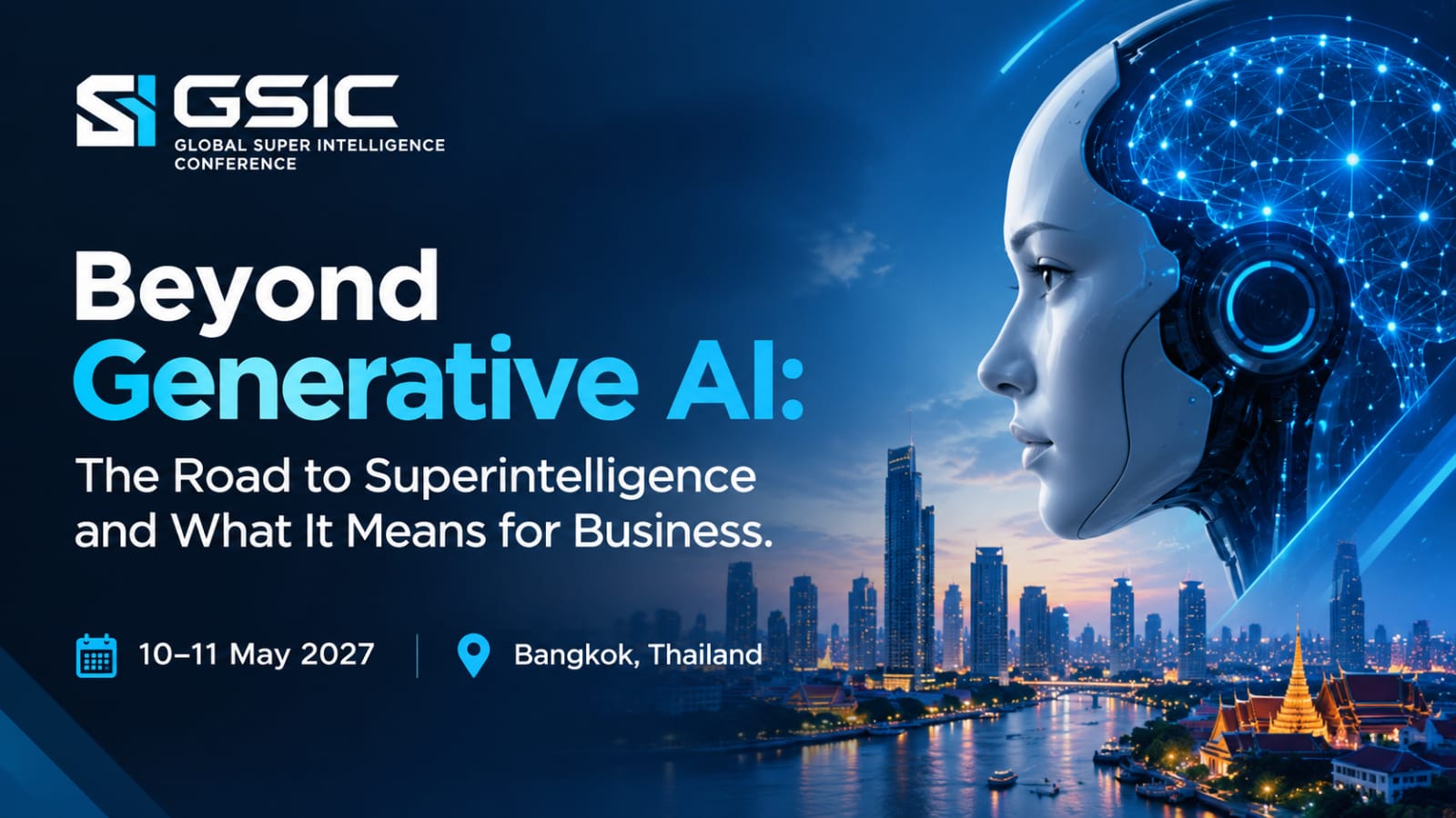
The Global Super Intelligence Awards & Conference 2027 (GSIC) in Bangkok on 10–11 May 2027 will bring together researchers, founders, enterprise leaders, investors and policymakers to discuss advanced AI, agentic systems, computing infrastructure, safety and business transformation.
Register your interest in GSIC 2027 to explore how advances in AI could shape enterprise strategy, innovation and the future of work.