AI agents are becoming a new class of digital workers. They can search information, use enterprise tools, communicate with other systems, execute workflows, and act on behalf of employees. But as their autonomy increases, so does a critical question: who—or what—is accountable when an AI agent acts?
The answer begins with identity. Enterprises have long managed access for employees, contractors, applications, and service accounts. AI agents now require the same discipline—but with stronger controls, because they can operate across systems, make decisions, and trigger real-world actions.
The identity gap
According to Gartner, by 2028, 25% of enterprise security breaches will be linked to AI agent abuse, driven by unmanaged machine privileges and legacy credential practices. This highlights the growing need for identity controls designed specifically for autonomous AI systems.
The risk is not theoretical. In December 2025, Microsoft identified a malicious browser extension with more than 600,000 installations that harvested ChatGPT and DeepSeek conversation histories. The activity affected nearly 10,000 organizations before it was mitigated. The incident illustrates how AI-related tools can become an entry point for data exposure when identity, permissions, and data boundaries are not properly governed.
Microsoft’s 2026 Digital Defense Report also found that 88% of enterprises are already experimenting with AI agents, while industry projections point to roughly 1.3 billion AI agents in production by 2028. Without an identity-first security model, agent adoption can quickly create an invisible and unmanaged attack surface.
Why agents need their own identity
An AI agent should not simply inherit a user’s credentials. If an agent uses a person’s full access rights, a single compromised prompt, tool, or integration could expose far more data than intended.
A better model treats every agent as a first-class digital identity. Each agent should have a unique identity, a named owner, a defined purpose, and narrowly scoped permissions. It should only access the data, tools, and systems required for its task—and every action should be logged and attributable.
For example, a procurement agent may be allowed to compare supplier quotations, prepare purchase requests, and flag exceptions. It should not be able to approve payments, change supplier bank details, or access unrelated HR data. If the agent attempts an unusual action, risk-based controls should pause the workflow and escalate it to a human approver.
This approach separates what an agent is allowed to do from what a human user can do, reducing the impact of compromise while preserving auditability.
Building trust by design
Enterprises can secure the new digital workforce by applying five principles:
Discover every agent: Maintain a live inventory of agents, owners, purposes, and system access.
Assign unique identities: Avoid shared credentials and ensure every agent is individually accountable.
Apply least privilege: Limit each agent to task-specific data, tools, and actions.
Monitor behavior continuously: Detect unusual access, privilege escalation, and deviations from intended workflows.
Enable human control: Require approval for high-impact, sensitive, or irreversible decisions.
Treating AI agents as first-class digital identities, with lifecycle-managed identities, explicit roles, tightly scoped tool access, and end-to-end auditability, provides a foundation for enterprises to scale AI operations without creating uncontrolled security risks.
The strategic shift
AI agent identity is becoming a strategic requirement for organizations deploying autonomous systems. Strong identity controls help enterprises scale AI while reducing the risks of data exposure, compliance failures, operational disruption, and loss of customer trust.
The next phase of AI transformation will depend not only on what agents can do, but also on how securely, transparently, and accountably they operate.
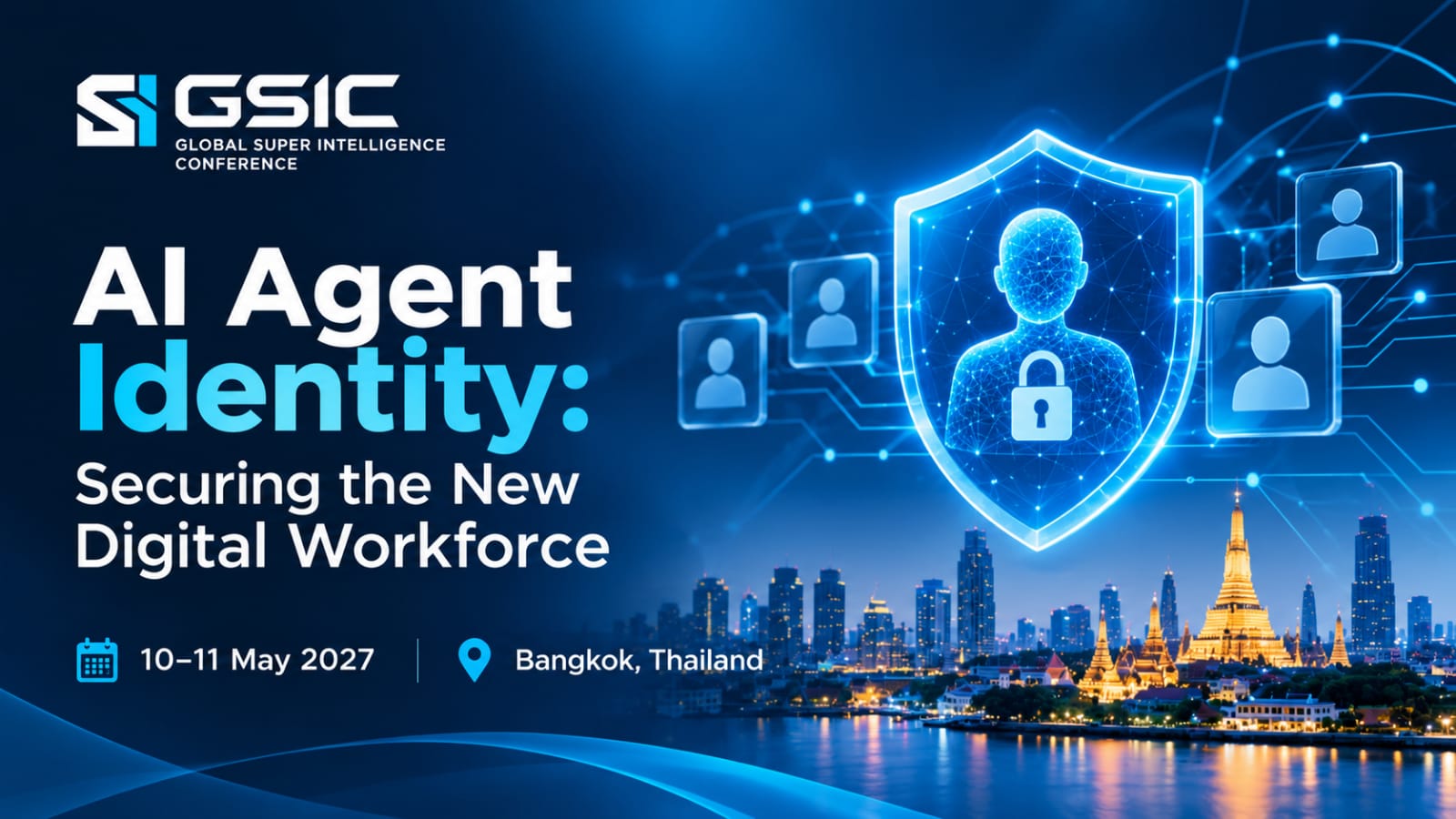
Learn how leading organizations are securing the new digital workforce at the Global Super Intelligence Awards & Conference 2027 (GSIC) in Bangkok on 10–11 May 2027. Register now to join the conversation on AI agent identity, governance, and trustworthy autonomy.