For years, enterprise AI has mainly served as a productivity tool—helping employees draft emails, analyze information, and generate code.
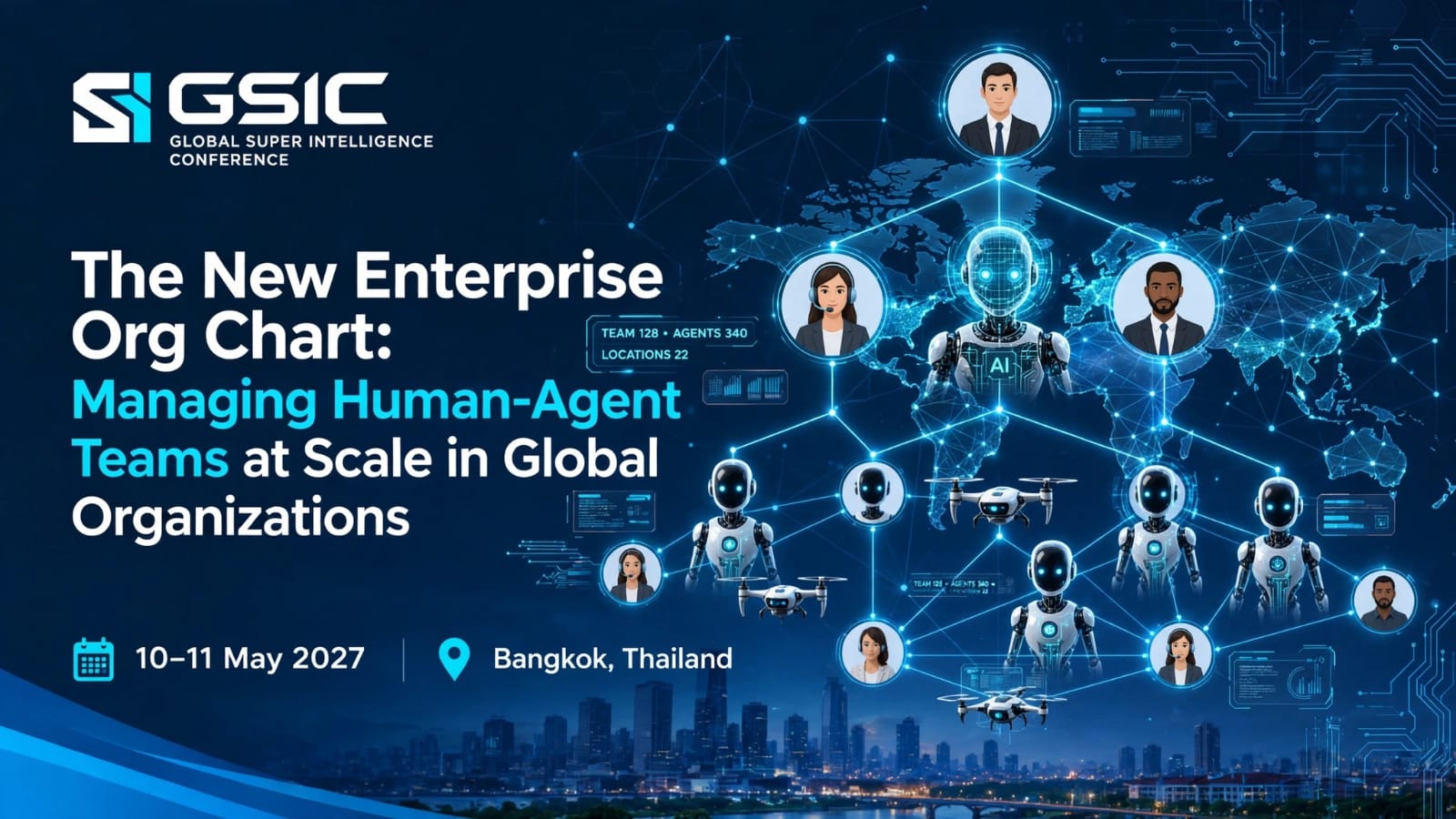
That is changing. As autonomous AI agents begin planning tasks, making decisions within defined limits, and executing multi-step workflows, organizations face a new challenge: traditional structures were designed for human employees, not human-agent teams.
When AI participates across departments and business operations, leaders must rethink how work is assigned, supervised, and governed. Success will require more than advanced models—it will require a new approach to organizational design, leadership, and accountability.
From Doers to Orchestrators: The Rise of the Manager of Agents
In traditional organizations, managers oversee employees who perform specific tasks. In an AI-enabled enterprise, employees will increasingly coordinate specialized AI agents that handle different parts of a business process.
Consider customer onboarding or supply-chain management. A traditional workflow may require several employees to review documents, check compliance requirements, communicate with vendors, and update enterprise systems.
With AI agents, many of these activities can be automated or supported by specialized systems. One agent might extract information from documents, another could conduct an initial risk assessment, while others manage routine communications or identify exceptions requiring human attention.
Human employees would then focus on supervising these workflows, reviewing important decisions, and handling situations that require professional judgment.
This transition is changing the skills organizations need:
Task scoping replaces routine execution: Employees must translate business objectives into clear instructions, operating boundaries, and measurable outcomes that AI agents can follow.
Exception management becomes more important: As routine activities become increasingly automated, human attention can shift towards unusual cases, complex decisions, and situations requiring judgment.
Continuous oversight becomes essential: Employees must monitor agent performance, identify inaccurate outputs, detect changes in behavior, and address problems before they affect wider operations.
The emerging role is not simply an employee using AI. It is an orchestrator responsible for coordinating people, agents, and business processes.
Solving the Accountability Gap
One of the biggest challenges in deploying autonomous AI agents is establishing clear accountability.
If an AI-powered procurement agent recommends an unsuitable supplier, approves an incorrect transaction, or sends inaccurate information to a business partner, who is responsible?
The AI system cannot independently assume organizational or legal responsibility. Accountability must remain with the people and institutions that design, deploy, authorize, and supervise these systems.
Organizations need clear decision-making structures before granting agents greater operational autonomy.
Three governance practices are particularly important:
1. Establish Bounded Autonomy Zones
Organizations should define what agents can do independently and which decisions require human approval.
For example, a customer-service agent might be authorized to approve routine refunds up to a specified limit, while larger amounts require managerial review. High-risk transactions may require additional compliance checks or direct human authorization.
These boundaries should reflect the organization’s financial exposure, regulatory obligations, and operational risks.
2. Assign Named Human Owners
Every production AI agent or multi-agent workflow should have a designated human owner.
This person should be responsible for its operational performance, permissions, monitoring arrangements, and escalation procedures.
Clear ownership prevents responsibility from becoming fragmented across IT, business operations, and external technology providers.
3. Make Audit Trails Standard Practice
Organizations should maintain records of material agent activities, including system access, data retrieval, decisions, approvals, and external communications.
These records should enable authorized employees to understand what an agent did, which information influenced its actions, and whether it operated within approved boundaries.
Transparent audit trails are particularly important in regulated industries, where organizations may need to demonstrate and explain how automated decisions were made.
Three Steps to Redesign Your Team Structure
Organizations do not need to undertake an immediate company-wide restructuring to prepare for human-agent collaboration. They can begin with a few practical changes.
1. Map workflows, not just job titles
Start by identifying a high-volume business process and breaking it into individual activities and decisions. Determine which steps can be handled through conventional software, which could benefit from AI agents, and which should remain under human supervision.
This approach helps organizations identify realistic automation opportunities without removing necessary human oversight.
2. Build a cross-functional Agent Operations function
AI deployment should not be treated as an IT project alone. Technology, cybersecurity, legal, compliance, human resources, and operational teams need to work together when designing and managing agent-based workflows.
A dedicated Agent Operations function can coordinate deployment standards, permissions, performance monitoring, and risk management across departments.
3. Redefine organizational performance metrics
Traditional performance measures often focus on employee productivity, working hours, and the number of tasks completed. Human-agent teams require a broader set of indicators.
Organizations should also measure workflow efficiency, output accuracy, escalation quality, human intervention requirements, and the ability to contain errors.
The objective should not simply be to automate more tasks. It should be to improve business outcomes while maintaining accountability and operational control.
Looking Ahead to GSIC 2027
The next phase of enterprise AI will be shaped not only by advances in model capabilities but also by how effectively organizations integrate intelligent agents into their existing structures.
Companies that establish clear responsibilities, effective human oversight, and reliable governance frameworks will be better positioned to use autonomous AI across complex business operations.
The future enterprise will not be defined by humans or AI agents working independently. It will depend on how successfully both work together within coordinated, accountable, and adaptable organizational structures.
Join leaders shaping the next era of enterprise AI at Global Super Intelligence Awards and Conference (GSIC) 2027 in Bangkok.
Register now https://globalsiconference.com
References
McKinsey & Company — The rise of the agentic coworker: A banking CIO’s guide to the next wave of AI
Deloitte — Why C-suite leaders need to rethink organization design for AI