
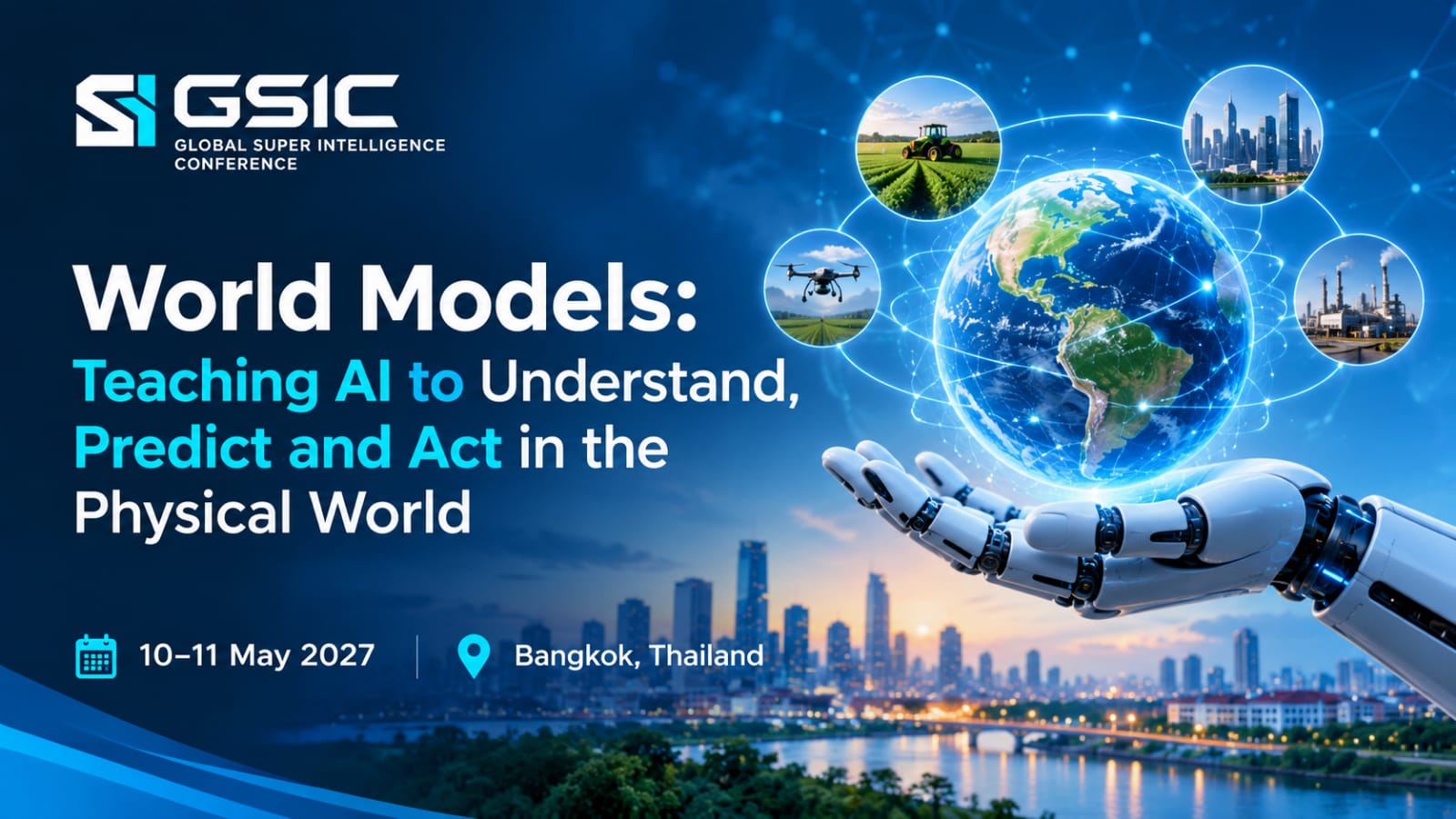
Artificial intelligence has become highly capable at understanding language, generating content, and supporting digital workflows. But the next frontier is different: AI systems that can understand the physical world, anticipate what may happen next, and act safely within it.
This is the promise of world models. Unlike traditional AI systems that mainly recognize patterns in data, world models learn how environments behave over time. They can represent objects, movement, space, cause and effect, and likely future states—allowing machines to simulate outcomes before taking action.
For enterprises, this shift could be as significant as the move from static analytics to generative AI. World models may enable robots, autonomous vehicles, factories, warehouses, and smart cities to operate with greater awareness, adaptability, and safety.
From perception to prediction
A conventional AI vision system can identify an object in an image: for example, it may recognize a person, a vehicle, or a pallet in a warehouse. A world model goes further. It can infer how the scene is likely to evolve, assess possible risks, and determine what action would produce the safest or most effective outcome.
NVIDIA describes world models as systems that understand real-world dynamics, including physics, spatial and temporal relationships, and environmental properties. They use input data to predict how a scene may change in response to an action. In practical terms, this means an autonomous system does not merely react to what it sees—it reasons about what could happen next.
This capability is essential in environments where mistakes are costly. A warehouse robot must understand the weight and fragility of an item before choosing its grip and placement. An autonomous vehicle must anticipate how pedestrians, cyclists, and other vehicles may move. A factory system must detect a developing fault before it disrupts production.
NVIDIA Cosmos: Teaching AI to Simulate the Physical World
NVIDIA’s Cosmos family illustrates how world models are moving from research into practical physical AI. Cosmos 3 combines vision reasoning, world generation, and action generation, enabling systems to understand object interactions, motion, and spatial-temporal relationships before generating action trajectories.
Developers such as FieldAI and Skild AI are using Cosmos world models for data generation and simulation to build more generalised robot intelligence. CMR Surgical is also using Cosmos-based simulation to train and validate robotic intelligence for its Versius surgical system before clinical deployment.
By generating diverse synthetic scenarios, including rare edge cases, Cosmos helps teams test and refine physical AI systems before deployment. NVIDIA’s Physical AI Data Factory Blueprint supports this approach through large-scale data processing, synthetic data generation, reinforcement learning, and evaluation.
Why it matters for business
World models could reduce the cost and risk of deploying physical AI. By allowing machines to learn and be tested in high-fidelity virtual environments, organizations can improve safety, shorten development cycles, and expand automation into settings that were previously too complex or unpredictable.
They may also create a foundation for more capable industrial systems. A robot trained through world models could generalize across different layouts, products, and operating conditions rather than needing to be reprogrammed for every new task. NVIDIA reports that robotics developers using Cosmos-based approaches can master new tasks with minimal retraining.
The broader implication is clear: physical AI will not succeed through sensors and algorithms alone. It will require systems that can understand context, reason about consequences, and act responsibly in the real world.
The road ahead
World models are still an emerging technology, and their reliability depends on high-quality data, robust validation, and strong safety governance. But their potential is substantial. As AI moves beyond screens and into factories, hospitals, roads, farms, and cities, world models could become the bridge between digital intelligence and physical action.
For business and technology leaders, the question is no longer whether AI will enter the physical world. It is how quickly organizations can build the data, simulation, and governance capabilities needed to deploy it safely.
Explore the future of physical AI, robotics, and autonomous intelligence at the Global Super Intelligence Awards & Conference 2027 (GSIC) in Bangkok on 10–11 May 2027.