Artificial intelligence is evolving beyond task automation and content generation towards more advanced reasoning, autonomous systems, and complex decision-making. As these capabilities develop, important questions are emerging around the future of intelligence, its practical applications, and the challenges involved in building increasingly capable AI systems.
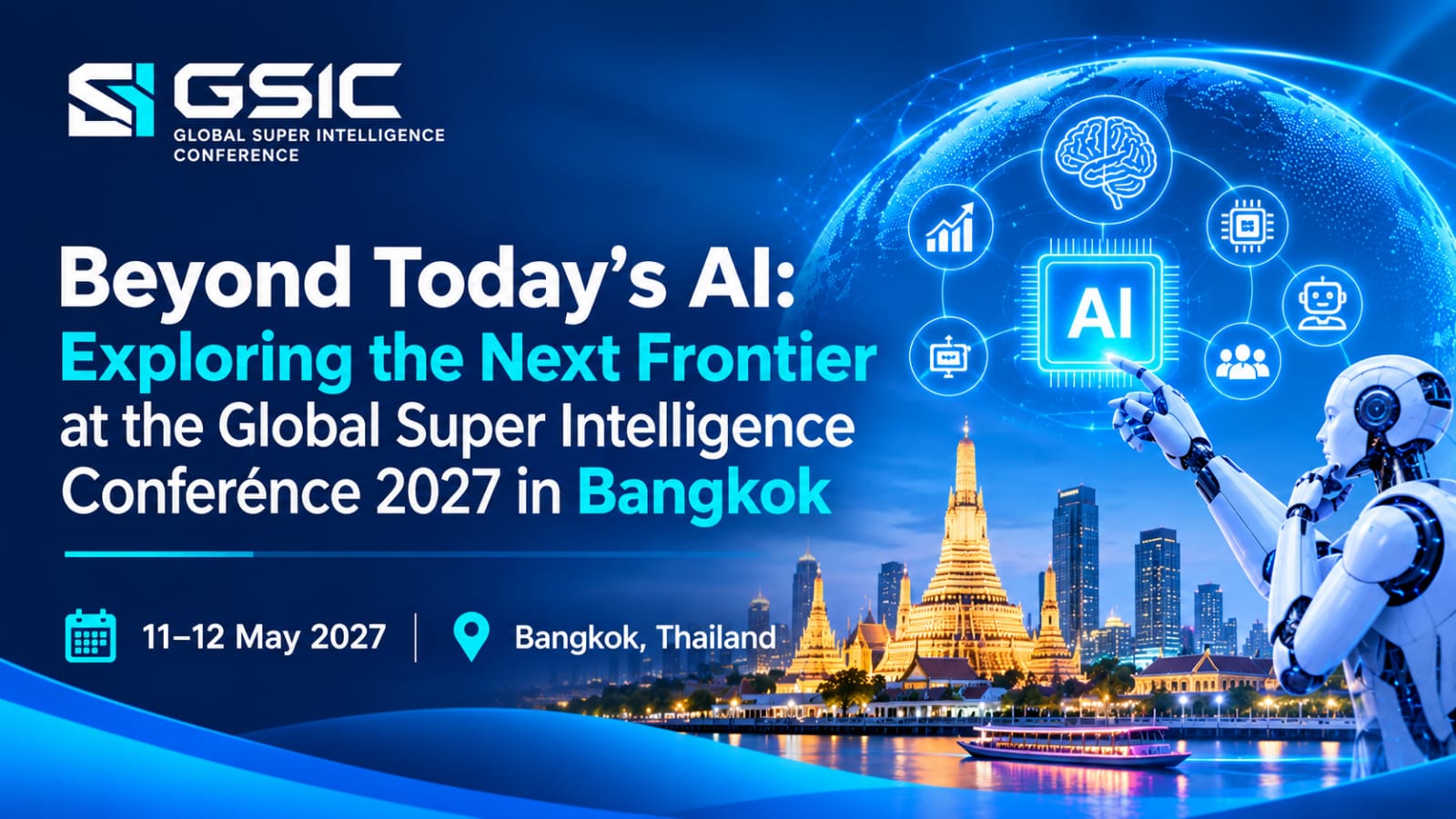
The Global Super Intelligence Awards & Conference 2027 (GSIC) will take place in Bangkok, Thailand, on 11–12 May 2027. The event will bring together researchers, technology leaders, enterprise executives, policymakers, and investors to discuss developments shaping the future of artificial intelligence.
The conference will explore several areas influencing the next phase of AI, from advanced autonomous systems and AI governance to computing infrastructure and the wider impact of emerging technologies.
Deep Dives into Frontier AI and Autonomy
Artificial intelligence is moving beyond systems designed for specific tasks towards more advanced models capable of reasoning, planning, and handling multiple stages of a process. Multi-agent systems are also gaining attention as different AI agents begin working together to complete complex tasks.
These developments raise important questions about reliability, coordination, memory, and decision-making. Research into artificial general intelligence (AGI) is also expanding discussions about the capabilities and limitations of future AI systems.
Understanding these developments will be important as organizations explore how increasingly autonomous technologies can be applied in business, research, and other sectors.
Practical Governance, Safety, and Alignment
As AI systems become more capable and autonomous, questions around safety, accountability, and responsible deployment are becoming increasingly important.
AI governance involves establishing clear rules for how systems are developed, tested, monitored, and used. Frameworks such as the NIST AI Risk Management Framework help organizations identify and manage AI-related risks. Key considerations include transparency, data protection, bias, human oversight, and accountability when automated systems make decisions.
AI alignment and safety research also focus on ensuring that advanced systems operate within intended boundaries and remain consistent with human values and objectives. International regulatory approaches will play an important role in shaping how these technologies develop and are adopted.
Next-Generation Compute and Infrastructure
Advances in AI depend on improvements in computing infrastructure, energy resources, and data management. As AI systems become more complex, the demand for computing power and efficient infrastructure continues to grow.
Key areas include sustainable data centers, sovereign AI, edge computing, cloud infrastructure, and energy-efficient model training. These developments will influence how future AI systems are built, deployed, and scaled.
Access to advanced chips, reliable energy supplies, and secure data infrastructure will also remain important considerations for countries and organizations investing in AI capabilities.
AI Innovation, Investment, and Industry Collaboration
The growth of artificial intelligence is creating opportunities for startups, technology providers, research institutions, and established enterprises. New developments are emerging across areas such as healthcare, financial services, manufacturing, cybersecurity, and enterprise automation.
Investment in AI infrastructure, foundational models, and specialized applications is also influencing the direction of the industry. Collaboration between technology developers, businesses, and research institutions can help move promising ideas from development into practical applications.
Industry exhibitions, startup showcases, and business discussions provide opportunities to explore these developments and understand how different organizations are approaching AI adoption.
Recognizing Advances Through the Global Super Intelligence Awards
The Global Super Intelligence Awards form an important part of the event, recognizing contributions to artificial intelligence research, development, and implementation.
Recognition across areas such as technical innovation, enterprise applications, and responsible AI can highlight the organizations, researchers, and individuals contributing to the field. Such initiatives also provide an opportunity to examine how AI progress is being translated into practical outcomes.
Why Bangkok, and Why Now?
Southeast Asia is becoming an increasingly important region for digital transformation and artificial intelligence adoption. Governments and businesses across the region are exploring AI applications, investing in digital infrastructure, and developing strategies to strengthen their technology capabilities.
Bangkok provides a regional setting for discussions involving international technology companies, research communities, investors, and policymakers. Its position within Southeast Asia also creates opportunities to examine the different approaches to AI development and adoption across Asia-Pacific markets.
As artificial intelligence continues to advance, discussions around its capabilities, limitations, governance, and infrastructure will become increasingly important.
Join the Global Super Intelligence Conference 2027
The Global Super Intelligence Awards & Conference 2027 in Bangkok will provide a platform for exploring these developments and the questions shaping the next phase of AI.
For more information about the conference, awards, and participation opportunities, visit https://globalsiconference.com