
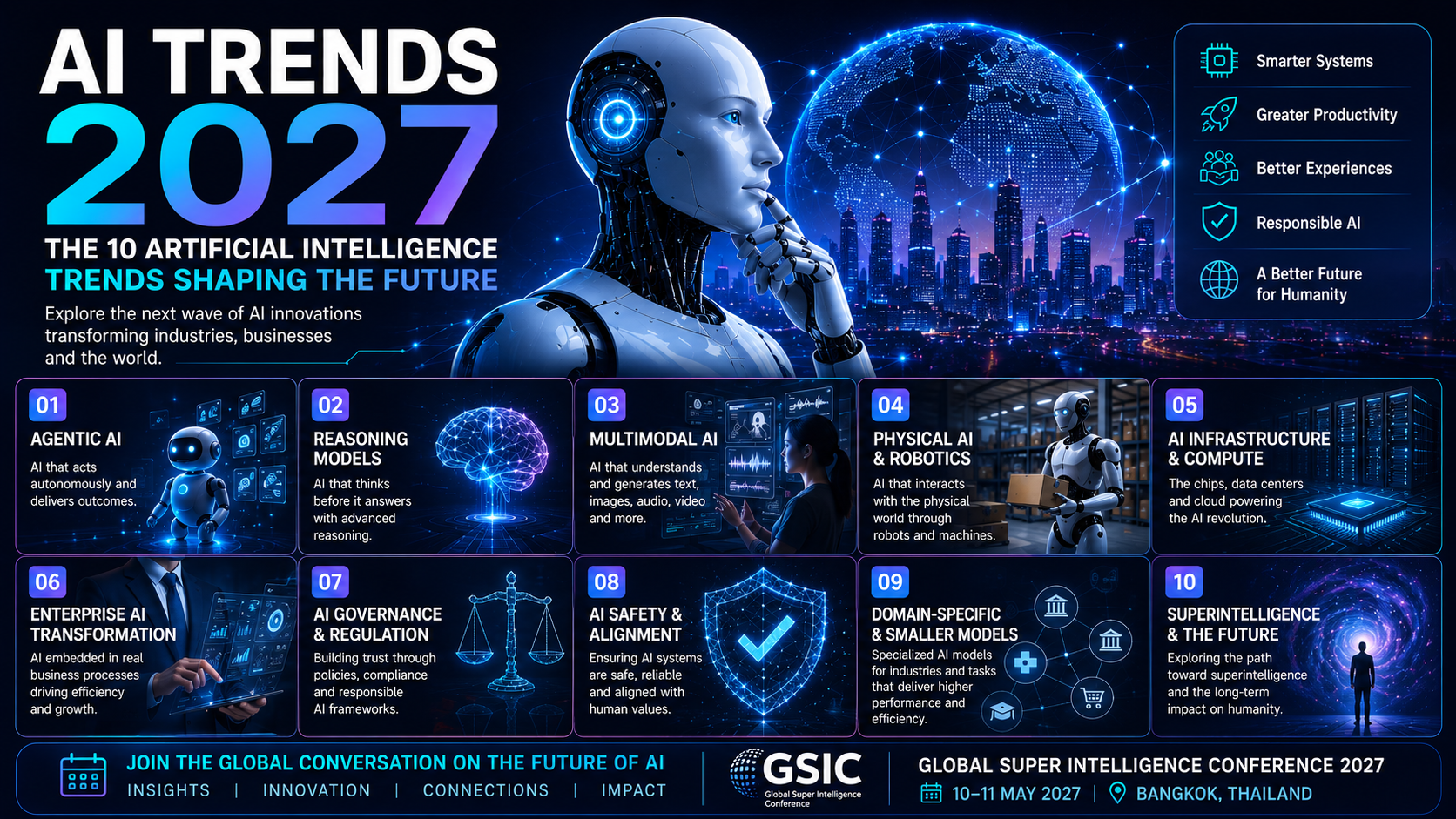
AI Trends 2027: The 10 Artificial Intelligence Trends Shaping the Future
Artificial intelligence is moving into a new phase.
The conversation is no longer limited to chatbots, image generators or AI-powered search. Artificial intelligence is increasingly being integrated into business processes, software development, scientific research, robotics, healthcare, finance, manufacturing and everyday digital services.
As we move toward 2027, several AI technologies are expected to become increasingly important. Agentic AI, reasoning models, multimodal systems, physical AI, AI infrastructure, enterprise AI, AI governance and AI safety are among the areas attracting significant attention from technology companies, researchers and organizations.
The 2026 Stanford AI Index reports that AI capabilities continued to accelerate, with industry producing more than 90% of notable frontier models in 2025 and organizational AI adoption reaching 88%. The report also highlights rapid progress across language, image, video, speech, reasoning, robotics and agentic systems.
At the same time, the growing capabilities of AI are creating new questions around security, governance, cost, infrastructure, accountability and responsible deployment.
So, what could define the AI landscape in 2027?
Here are 10 artificial intelligence trends to watch in 2027.
1. Agentic AI Will Move From Experiments Toward Real-World Workflows
One of the most important AI trends for 2027 is the continued development of agentic AI.
Traditional generative AI systems generally respond to prompts by producing text, images, code or other outputs.
Agentic AI goes further.
AI agents can be designed to understand goals, plan tasks, use tools, retrieve information, interact with software and take actions with varying levels of human supervision.
For example, instead of asking an AI assistant to summarize a sales report, an organization could use an AI agent to:
Collect sales data.
Analyze performance.
Identify unusual changes.
Prepare a report.
Recommend actions.
Send the report to the relevant team.
This shift from AI that generates content to AI that performs tasks could have major implications for enterprise technology.
Gartner's 2026 research highlights the growing importance of agentic AI while also emphasizing the need for governance, security and cost management as autonomous systems become more capable.
Why agentic AI matters in 2027
Businesses are increasingly interested in AI that can produce measurable outcomes rather than simply generate content.
Potential applications include:
Customer service
Software development
Financial analysis
Supply-chain management
Sales automation
Research
IT operations
Business intelligence
Marketing
Knowledge management
However, autonomous systems also introduce new risks.
An AI agent with access to corporate databases, emails, payment systems or APIs can potentially create consequences beyond a simple incorrect answer.
This means agentic AI and AI governance will increasingly need to develop together.
2. Reasoning Models Will Become More Important
Another major AI trend for 2027 is the development of models capable of handling increasingly complex reasoning tasks.
Early generative AI systems became widely known for generating fluent text. Newer AI systems are increasingly designed to perform multi-step reasoning, coding, mathematical analysis, planning and scientific problem-solving.
The Stanford AI Index tracks substantial improvements in AI performance across reasoning, coding, science and other benchmarks.
Reasoning capabilities can make AI systems more useful for tasks where simply predicting the next word is not enough.
Potential applications include:
Scientific research
Engineering
Mathematics
Software development
Financial modeling
Legal research
Strategic planning
Data analysis
Complex decision support
The important shift is from content generation toward problem solving.
In 2027, organizations may increasingly evaluate AI models based not only on how naturally they communicate, but on how reliably they can solve difficult, multi-step problems.
3. Multimodal AI Will Become the Standard
Human beings interact with the world through multiple forms of information.
We see images, hear sounds, read text, understand video and interact with physical environments.
AI systems are increasingly moving in the same direction.
Multimodal AI combines multiple types of data, such as:
Text
Images
Audio
Video
Speech
Documents
Sensor information
This means an AI system could potentially analyze a video, understand spoken instructions, inspect an image and generate a written report as part of one workflow.
Gartner identifies multimodal capabilities as one of the important forces expected to support the scaling of generative AI, alongside domain-specific models, reasoning models and agentic AI.
Multimodal AI applications
In healthcare, multimodal systems could combine medical images, patient records and clinical information.
In manufacturing, AI could analyze camera feeds, machine data and maintenance documents.
In education, AI systems could combine textbooks, lectures, diagrams and student interactions.
In customer service, AI could understand voice conversations, screenshots and written messages.
As multimodal models improve, the distinction between different AI applications may become less important.
Instead, organizations could interact with a single AI system capable of understanding many types of information.
4. Physical AI and Robotics Will Expand
AI is increasingly moving beyond screens.
The combination of artificial intelligence, robotics, computer vision, sensors and advanced computing is creating what is often called physical AI.
Physical AI refers broadly to AI systems capable of perceiving and interacting with the physical world.
This includes:
Robots
Autonomous vehicles
Industrial automation
Drones
Humanoid robots
Smart machines
Warehouse robotics
Autonomous systems
Gartner's 2027 strategic predictions place strong emphasis on “robots everywhere,” reflecting expectations that robotics and autonomous systems will become increasingly integrated into physical environments.
The development of physical AI depends on more than better AI models.
It also requires:
Sensors
Robotics hardware
Edge computing
Computer vision
Real-time processing
Simulation
Advanced batteries
Reliable communication networks
Safety systems
This makes physical AI an intersection between artificial intelligence, robotics, semiconductor technology and engineering.
For 2027 and beyond, the AI industry will increasingly focus not only on what intelligent systems can generate, but on what intelligent systems can do in the physical world.
5. AI Infrastructure and Compute Will Become Strategic Priorities
Advanced AI requires enormous amounts of computing infrastructure.
Training and running sophisticated AI models depends on:
GPUs and AI accelerators
Data centers
Networking
Storage
Cloud infrastructure
Energy
Cooling systems
Specialized software
As AI adoption grows, infrastructure becomes a strategic consideration rather than simply an IT issue.
The 2026 Stanford AI Index reports that the United States hosts more than 5,400 data centers and highlights the growing infrastructure and environmental footprint associated with AI.
Research from Google Cloud also found that organizations scaling agentic AI are encountering infrastructure, security, governance and operational challenges.
Why AI compute matters
The future AI race will not depend solely on algorithms.
It will also depend on access to:
Computing power
High-performance chips
Data
Energy
Networking
Skilled AI engineers
Efficient inference infrastructure
This is one reason why AI infrastructure and compute are likely to remain major themes throughout 2027.
6. Enterprise AI Will Move From Pilots to Business Processes
Many organizations have experimented with generative AI.
The next stage is turning those experiments into systems that operate inside real business processes.
This means organizations will increasingly ask:
Does AI actually create measurable business value?
Enterprise AI could become embedded into:
Customer service
Finance
Human resources
Marketing
Software development
Procurement
Supply chains
Operations
Research and development
Business intelligence
The Stanford AI Index reports that organizational AI adoption has already reached high levels, indicating that AI is moving beyond isolated experiments into broader organizational use.
However, adoption does not automatically mean successful implementation.
Companies still need:
High-quality data
AI skills
Cybersecurity
Governance
Integration
Change management
Reliable evaluation
Clear business objectives
The enterprise AI trend in 2027 is therefore likely to be less about simply using AI and more about integrating AI into how organizations operate.
7. AI Governance and Regulation Will Become Core Infrastructure
As AI becomes more autonomous and more deeply integrated into business and public systems, governance will become increasingly important.
AI governance involves the policies, processes and technical controls used to manage AI systems responsibly.
Important areas include:
Data governance
Model evaluation
Transparency
Human oversight
Security
Privacy
Risk management
Accountability
Compliance
AI system monitoring
Stanford's 2026 AI Index highlights a widening gap between AI capability and the frameworks available to measure and manage those capabilities.
Gartner is also emphasizing AI governance technologies, runtime oversight and accountability as organizations scale autonomous AI systems.
This means AI governance is increasingly becoming part of the technical architecture of AI—not simply a policy document.
In 2027, businesses may increasingly need governance systems capable of monitoring AI activity in real time.
8. AI Safety and Alignment Will Become More Important
As AI systems become more capable, researchers and organizations are paying greater attention to AI safety and alignment.
AI alignment broadly concerns whether AI systems behave in ways consistent with intended goals, human instructions and appropriate constraints.
AI safety can involve questions such as:
How reliable is an AI system?
What happens when it makes an error?
Can it be manipulated?
Can it access sensitive information?
Can an AI agent take unauthorized actions?
How should humans supervise autonomous systems?
How can dangerous behavior be detected?
The 2026 Stanford AI Index reports that documented AI incidents increased substantially, while also noting persistent measurement gaps around responsible AI.
As AI moves from generating answers to taking actions, safety considerations become increasingly important.
For this reason, AI safety and alignment are likely to remain central topics in 2027, particularly for frontier models and autonomous systems.
9. Domain-Specific and Smaller AI Models Will Grow
Not every organization needs the largest possible AI model.
In many situations, a smaller or domain-specific model can provide advantages in:
Cost
Speed
Privacy
Customization
Deployment
Reliability
Specialized knowledge
Gartner identifies domain-specific models as an important direction for the evolution of generative AI, particularly where organizations need systems tailored to specific industries and tasks.
This could lead to more specialized AI models for areas such as:
Healthcare
Finance
Manufacturing
Law
Education
Energy
Retail
Scientific research
Cybersecurity
The future AI ecosystem may therefore consist of many different models rather than a single universal model.
Some organizations may use large general-purpose models, while others use smaller specialized systems optimized for particular tasks.
10. Superintelligence and the Future of AI Will Become Bigger Strategic Questions
The tenth trend is broader than a specific technology.
As AI systems become more capable, researchers, companies and policymakers are increasingly discussing what future generations of artificial intelligence could look like.
This includes questions around:
Frontier AI
Artificial general intelligence
Superintelligence
Autonomous systems
AI-powered scientific discovery
Human-AI collaboration
AI safety
AI governance
The future of work
Long-term societal impact
The Stanford AI Index shows that AI capabilities continue to advance across multiple dimensions, including reasoning, science, robotics and agentic systems.
At the same time, the discussion around advanced AI increasingly extends beyond model performance toward questions of governance, accountability, infrastructure and societal impact.
This is particularly relevant to the Global Super Intelligence Conference, which brings together discussions around frontier AI, agents and autonomy, AI infrastructure and compute, AI safety and alignment, enterprise AI transformation, and AI governance.
The growing interest in superintelligence makes it an important area to follow as organizations and researchers consider what increasingly capable AI systems could mean for the future.
AI Trends 2027 at a Glance
AI Trend | What It Means |
|---|---|
Agentic AI | AI systems that can plan, use tools and perform tasks |
Reasoning AI | Models designed for complex multi-step problem solving |
Multimodal AI | AI that understands text, images, audio, video and other data |
Physical AI | AI systems operating in the physical world |
AI Infrastructure | Chips, data centers, cloud, networking and compute |
Enterprise AI | AI integrated into real business processes |
AI Governance | Policies and technical controls for responsible AI |
AI Safety & Alignment | Making increasingly capable AI systems reliable and controllable |
Domain-Specific AI | Specialized models optimized for industries and tasks |
Superintelligence | Long-term questions around increasingly advanced AI systems |
How Businesses Can Prepare for AI Trends in 2027
Organizations preparing for the next stage of AI should look beyond simply purchasing an AI tool.
A practical strategy can include five areas.
1. Identify high-value use cases
Start with business problems rather than technology.
Determine where AI can improve productivity, customer experience, decision-making or research.
2. Build strong data foundations
AI systems depend heavily on the quality, availability and governance of data.
Organizations should understand where their data is stored, how it is used and who can access it.
3. Prepare for AI agents
If organizations plan to use autonomous AI systems, they should consider permissions, identity, monitoring and human oversight.
This is becoming increasingly important because agents can take actions rather than simply provide information. Google Cloud's 2026 infrastructure research specifically highlights security and governance as major challenges for scaling autonomous AI systems.
4. Invest in AI skills
AI adoption requires more than software.
Organizations need people who understand:
AI development
Data
Cybersecurity
AI governance
Model evaluation
Business strategy
Responsible AI
5. Measure value and risk
AI projects should be evaluated using measurable outcomes.
Organizations should consider:
Cost
Productivity
Accuracy
Reliability
Security
Compliance
User experience
Business impact
This becomes especially important as AI workloads become more autonomous and computationally expensive.
Why AI Conferences Matter in 2027
The pace of AI development makes conferences an important source of knowledge and industry connection.
AI conferences provide opportunities to:
Hear from AI researchers
Meet technology companies
Discover startups
Explore emerging AI products
Understand enterprise applications
Discuss AI governance
Learn about AI infrastructure
Explore investment opportunities
Build international partnerships
Follow developments in frontier AI
For AI professionals, the value of conferences increasingly comes from bringing different parts of the ecosystem together.
Researchers may meet entrepreneurs.
Startups may meet investors.
Enterprise leaders may discover new technologies.
Policymakers may engage with researchers and technology companies.
That cross-sector interaction becomes particularly important as AI increasingly affects multiple industries simultaneously.
Global Super Intelligence Conference 2027: Exploring the Future of AI
The Global Super Intelligence Conference 2027 in Bangkok is designed around many of the AI developments discussed in this article.
Taking place on 10–11 May 2027, the conference, expo and awards platform brings together discussions around areas including:
Frontier AI
Superintelligence
Agents and autonomy
AI infrastructure and compute
AI safety and alignment
Enterprise AI transformation
AI governance and regulation
These areas reflect some of the central questions facing the AI industry as increasingly capable systems move from research environments into organizations and real-world applications.
For researchers, entrepreneurs, technology leaders, investors, enterprises and policymakers, AI conferences such as GSIC can provide an opportunity to exchange ideas and examine the technologies shaping the next phase of artificial intelligence.
The Future of Artificial Intelligence in 2027
The biggest AI story of 2027 may not be a single model or product.
Instead, it may be the convergence of several technologies.
Agentic AI + reasoning + multimodal models + robotics + infrastructure + enterprise software + governance could create new categories of AI systems capable of performing increasingly complex tasks.
At the same time, the challenges will become more complicated.
AI systems will need to be:
More capable
More reliable
More secure
More efficient
More transparent
More governable
The AI industry is therefore entering a period where capability and control need to develop together.
Current research already points toward this shift. Stanford's AI Index describes rapid capability improvements alongside gaps in responsible-AI measurement and governance, while Gartner's 2026 research emphasizes control, cost and accountability as organizations scale AI and autonomous systems.
Conclusion
The artificial intelligence landscape is changing rapidly, and 2027 is likely to bring another significant stage of development.
The 10 AI trends discussed in this article—agentic AI, reasoning models, multimodal AI, physical AI, AI infrastructure, enterprise AI, AI governance, AI safety and alignment, domain-specific models, and superintelligence—represent important areas to watch.
Some technologies will mature quickly. Others may take longer than expected. But together they illustrate how AI is expanding from content generation into reasoning, autonomous action, physical environments, enterprise systems and scientific discovery.
For organizations, researchers and technology professionals, understanding these developments will be increasingly important.
And for the global AI community, the central question is becoming broader than “What can AI do?”
It is also:
“How should increasingly capable AI be developed, deployed, governed and used?”
That conversation will be an important part of the future of artificial intelligence—and a central theme for the AI ecosystem heading into 2027.
Frequently Asked Questions
What are the biggest AI trends for 2027?
Major AI trends to watch in 2027 include agentic AI, reasoning models, multimodal AI, physical AI, AI infrastructure, enterprise AI, AI governance, AI safety, domain-specific models and discussions around superintelligence.
What is agentic AI?
Agentic AI refers to AI systems designed to pursue goals by planning tasks, using tools, interacting with systems and taking actions with varying levels of human supervision.
Will AI agents become more common in 2027?
AI agents are expected to receive increasing attention as organizations explore autonomous workflows. However, successful deployment will depend on factors including security, governance, infrastructure, cost and reliable evaluation. Gartner's current research emphasizes these challenges alongside the growth of agentic AI.
What is multimodal AI?
Multimodal AI refers to systems that can work with multiple types of information, such as text, images, audio, video and other data.
What is physical AI?
Physical AI describes AI systems that perceive and interact with the physical world. Robotics, autonomous vehicles, intelligent machines and humanoid robots are examples of areas associated with physical AI.
Why is AI infrastructure important?
Advanced AI systems require significant computing resources, including specialized chips, data centers, networking, storage and energy. As AI adoption grows, infrastructure becomes an increasingly important part of AI strategy.
What is AI governance?
AI governance includes the policies, processes and technical controls organizations use to manage AI systems, including risk, security, privacy, transparency, accountability and compliance.
What is AI alignment?
AI alignment broadly concerns designing AI systems so their behavior remains consistent with intended objectives, human instructions and appropriate constraints.
What is the future of enterprise AI?
Enterprise AI is increasingly moving toward integration with real business workflows. Organizations are exploring AI for customer service, software development, finance, operations, research, marketing and decision support.
What is Global Super Intelligence Conference 2027?
Global Super Intelligence Conference 2027 is an AI conference, expo and awards event taking place in Bangkok on 10–11 May 2027, with a focus on frontier AI, superintelligence, agents and autonomy, AI infrastructure, AI safety and alignment, enterprise transformation and AI governance.