Agentic AI in 2027: How AI Agents Are Transforming Business, Work & Automation
Artificial intelligence is entering a new phase.
For years, businesses primarily used AI to analyze information, generate content, answer questions and assist employees with individual tasks. The next stage is different: AI agents are increasingly being designed to understand goals, reason through problems, use digital tools and execute multi-step workflows with less human intervention.
This evolution is known as agentic AI.
As we move toward 2027, agentic AI is expected to become an increasingly important part of enterprise technology strategies. Instead of simply asking an AI system to produce an answer, organizations can increasingly give AI agents objectives such as resolving a customer issue, analyzing a business problem, preparing a report, coordinating a workflow or completing a software-development task.
The shift has significant implications for businesses, employees, software platforms and the future of automation.
According to the 2026 Stanford AI Index, organizational AI adoption reached 88% in 2025, while AI-agent deployment remained comparatively early across most business functions. This combination is important: businesses are already widely adopting AI, but agentic AI is still moving from experimentation toward broader deployment.
By 2027, the central question may no longer be whether businesses will use AI agents, but where agents should be deployed, what they should be allowed to do and how humans should work alongside them.
What Is Agentic AI?
Agentic AI refers to AI systems designed to pursue goals and perform actions rather than simply respond to individual prompts.
A traditional AI assistant might answer:
“What were our sales last quarter?”
An agentic system could potentially go much further.
For example, a business could ask an AI agent to:
Retrieve sales information.
Compare it with previous quarters.
Identify significant changes.
Analyze possible causes.
Prepare a management report.
Create visualizations.
Send the report to authorized executives.
The key difference is action and orchestration.
An AI assistant primarily helps a person perform a task. An AI agent can potentially perform a sequence of tasks on the person's behalf.
Agentic systems may combine:
Large language models
Reasoning models
Enterprise data
APIs
Software tools
Databases
Workflow systems
Retrieval systems
Memory and context
Planning mechanisms
Monitoring and evaluation
Human approval processes
This creates a new model of automation in which AI can participate directly in business workflows.
Why Agentic AI Matters in 2027
The growth of agentic AI is part of a broader transformation in enterprise technology.
Earlier generations of business automation were generally rules-based. Organizations created predefined workflows such as:
If X happens → perform Y.
Generative AI introduced more flexible interaction:
Give the AI information → ask it to create or analyze something.
Agentic AI adds another layer:
Give the AI a goal → allow it to determine and execute the steps required to achieve that goal within defined boundaries.
This makes agentic AI particularly relevant for complex workflows involving multiple systems, decisions and actions.
Research from Gartner indicates that only 17% of organizations had deployed AI agents at the time of its 2026 CIO and Technology Executive Survey, while more than 60% expected to deploy them within two years.
That suggests the technology is moving through an important transition from experimentation to implementation.
For businesses, 2027 could therefore become a critical period for establishing practical agent strategies.
1. AI Agents Will Move From Assistants to Digital Workers
One of the most important changes in agentic AI is the movement from AI assistants toward AI agents that execute work.
An assistant generally waits for a user request.
An agent can potentially:
Monitor information
Identify a task
Plan actions
Use software
Make decisions within defined limits
Complete multiple steps
Report results
Escalate exceptions to humans
This does not necessarily mean AI will replace employees.
Instead, organizations may increasingly treat AI agents as a new category of digital workforce capable of handling specific workflows.
For example, a finance organization could deploy an agent for invoice processing.
A customer-service organization could use agents for ticket classification and resolution.
A software company could deploy coding agents for testing, debugging and documentation.
A sales organization could use agents to research prospects, update CRM records and prepare account summaries.
The important shift is from AI generating information to AI executing processes.
2. Business Automation Will Become More Autonomous
Automation has existed for decades, but many traditional systems struggle with unstructured information and changing circumstances.
Agentic AI can potentially make automation more adaptable.
Consider a traditional workflow for processing a customer complaint.
A rules-based system may route the complaint according to predefined categories.
An AI agent could potentially:
Read the customer's message
Understand the problem
Review the customer's account
Check previous interactions
Search company policies
Determine available solutions
Draft or send an appropriate response
Issue an approved refund
Update the CRM
Escalate unusual cases
The result is a workflow in which multiple actions are coordinated by an AI system.
This is why agentic AI is increasingly associated with end-to-end automation rather than simple task automation.
3. AI Agents Could Transform Customer Service
Customer service is one of the most visible areas for agentic AI.
Traditional chatbots generally respond to frequently asked questions.
Agentic customer-service systems can potentially interact with business systems and take action.
A customer might say:
“My order hasn't arrived. Can you check what happened and arrange the next step?”
An agent could potentially:
Identify the customer.
Retrieve the order.
Check shipment information.
Determine the delivery status.
Review company policies.
Offer an approved resolution.
Update the order record.
Notify the customer.
Human employees can then focus on complex cases requiring judgment, empathy or specialized expertise.
This creates a potential model of human-agent collaboration, where AI handles high-volume operational work while people manage exceptions and higher-value interactions.
4. Software Development Will Become Increasingly Agentic
Software engineering is another major area of agentic AI development.
AI coding tools already assist developers with:
Code generation
Debugging
Documentation
Testing
Refactoring
Code explanation
Agentic coding systems extend this concept.
Instead of asking an AI to write one function, a developer may provide a broader objective such as:
“Add this feature, update the relevant components, write tests and prepare the changes for review.”
An agent can potentially break the objective into smaller tasks, inspect the codebase, modify files, run tests and identify errors.
Multiple agents could eventually specialize in different areas:
Planning agent
Coding agent
Testing agent
Security agent
Documentation agent
Review agent
This is an example of a multi-agent system, where specialized AI systems collaborate on a larger objective.
5. AI Agents Will Reshape Knowledge Work
Knowledge workers spend significant amounts of time searching for information, moving between applications, preparing documents, analyzing data and coordinating activities.
Agentic AI has the potential to automate portions of this work.
Consider a marketing manager preparing a campaign.
Instead of manually:
Researching competitors
Reviewing customer data
Analyzing trends
Creating a campaign brief
Preparing content
Building reports
the manager could delegate portions of the workflow to specialized agents.
One agent could conduct research.
Another could analyze customer data.
Another could prepare content.
Another could monitor campaign performance.
The human remains responsible for strategic direction and approval while agents perform portions of the operational workload.
This could change the nature of knowledge work from doing every task manually to directing, reviewing and managing AI-powered workflows.
6. Multi-Agent Systems Could Become More Important
A single AI agent can perform many tasks, but complex business processes may require multiple specialized agents.
This is where multi-agent systems become important.
Imagine an enterprise workflow involving:
Research Agent → Analysis Agent → Planning Agent → Execution Agent → Compliance Agent → Reporting Agent
Each agent could have a defined role and permission level.
For example:
Research Agent
Collects information from approved sources.
Analysis Agent
Processes the information and identifies patterns.
Planning Agent
Develops possible actions.
Execution Agent
Performs approved tasks.
Compliance Agent
Checks whether actions meet business and regulatory requirements.
Reporting Agent
Documents the results.
The advantage of this approach is specialization.
Rather than expecting one AI system to do everything, organizations can build networks of agents with different responsibilities.
Gartner has previously projected that collaborative AI agents could become an important stage in the evolution of enterprise applications, with agent ecosystems increasingly connecting multiple applications and business functions.
7. The Enterprise Software Experience Could Change
Agentic AI could also change how people interact with software.
Today, employees frequently open different applications to complete a single business process.
A sales employee may use:
CRM software
Email
Calendar
Spreadsheet software
Analytics tools
Communication platforms
An agentic interface could potentially sit above these systems.
Instead of opening five applications, the employee might say:
“Prepare the account review for tomorrow's meeting.”
The agent could retrieve information from approved systems and assemble the necessary material.
This does not necessarily eliminate enterprise applications.
Instead, it could change how users interact with them.
The traditional model is:
Human → Application → Data → Action
An emerging agentic model could look more like:
Human → AI Agent → Multiple Applications → Data → Actions
This is one reason agentic AI could have major implications for enterprise software.
8. AI Agents Will Need Access to Business Context
An intelligent agent is only as useful as the information and tools available to it.
Businesses therefore need to think beyond AI models.
They also need:
High-quality data
Secure APIs
Knowledge bases
Identity systems
Permissions
Workflow infrastructure
Monitoring
Evaluation
Reliable context
This is particularly important because agents may interact with multiple enterprise systems.
A poorly connected agent may produce impressive answers but have limited ability to execute real business processes.
Google Cloud's 2026 research on agentic infrastructure highlights the importance of enterprise data and infrastructure, with 83% of organizations surveyed saying they require infrastructure upgrades for production-grade agentic AI systems.
Therefore, the future of agentic AI is not just about better models.
It is also about building the infrastructure around those models.
9. Agentic AI Will Increase the Importance of AI Governance
More autonomy means more responsibility.
A chatbot that generates a poor answer creates one type of risk.
An AI agent that can access databases, modify records, communicate with customers or execute transactions creates a different level of risk.
Organizations therefore need to determine:
What can an agent access?
What actions can it perform?
What requires human approval?
What data can it see?
How are decisions recorded?
How can actions be reversed?
How is the agent monitored?
What happens when the agent makes a mistake?
Gartner predicted in 2026 that 40% of enterprises could demote or decommission autonomous AI agents by 2027 because of governance failures.
The lesson is significant.
Agentic AI cannot simply be deployed as another software feature.
Organizations need governance frameworks that reflect the autonomy, permissions and risk level of each agent.
10. AI Agent Security Will Become a Major Business Priority
Security becomes more complicated when AI systems can act.
An agent may have access to:
Internal documents
Customer information
Financial systems
Code repositories
Databases
Email
Business applications
If permissions are poorly designed, an agent could potentially expose or manipulate sensitive information.
Organizations therefore need security controls such as:
Identity and authentication
Every agent should have a clearly defined identity.
Least-privilege access
Agents should receive only the permissions necessary for their tasks.
Monitoring
Organizations need visibility into agent actions.
Audit trails
Important actions should be recorded.
Human approval
High-risk actions may require human authorization.
Testing
Agents need to be evaluated for reliability, security and unexpected behavior.
Continuous monitoring
Agent behavior can change as models, tools and business environments evolve.
The rise of agentic AI therefore creates a new intersection between AI engineering, cybersecurity and governance.
11. Agentic AI Will Change the Workplace
One of the biggest questions surrounding AI agents is the future of work.
The impact is unlikely to be uniform across every occupation.
Some tasks may become heavily automated.
Other tasks may become more AI-assisted.
Some new roles may emerge around:
AI agent management
AI workflow design
AI governance
Agent security
AI operations
Human-agent collaboration
AI evaluation
AI strategy
Employees may increasingly need to learn how to:
Delegate tasks to agents
Review AI outputs
Validate decisions
Manage agent workflows
Understand AI limitations
Design better processes
Work across human-AI teams
The valuable skill may therefore shift from simply using AI to orchestrating AI systems effectively.
12. Agentic AI Could Move Businesses From Task Automation to Outcome Automation
This may be one of the most important long-term developments.
Traditional automation focuses on individual tasks.
Agentic AI can potentially focus on outcomes.
For example:
Instead of:
“Generate a customer report.”
the instruction becomes:
“Identify customers at risk of leaving and prepare recommended retention actions.”
Instead of:
“Analyze sales data.”
the instruction becomes:
“Identify the major causes of declining regional sales and prepare an action plan.”
Instead of:
“Write a marketing email.”
the instruction becomes:
“Develop and prepare a campaign for this customer segment according to our approved brand guidelines.”
This represents a shift from task-based AI to goal-oriented AI.
13. Specialized AI Agents May Deliver More Business Value
Agentic AI does not necessarily mean creating one giant AI system capable of doing everything.
In many cases, specialization may be more practical.
For example:
HR agent
Finance agent
Sales agent
Procurement agent
Legal research agent
Customer-service agent
IT support agent
Cybersecurity agent
Supply-chain agent
Marketing agent
Each can be designed around a specific business process.
Recent Gartner analysis of more than 100 agentic AI deployments concluded that specialization is an important path to measurable ROI, with Gartner predicting that by 2028, 80% of tangible ROI from agentic AI will come from specialized, domain-specific agents.
This suggests that organizations planning for 2027 should focus not only on how intelligent an agent is, but how effectively it solves a specific business problem.
14. Agentic AI Will Create a New Challenge: Agent Sprawl
As organizations deploy more agents, another problem can emerge: too many agents.
Imagine a large enterprise with thousands of employees creating their own AI workflows.
Over time, the organization could accumulate hundreds or thousands of agents with different:
Permissions
Data sources
Objectives
Owners
Models
Integrations
Security settings
This creates AI agent sprawl.
Gartner has projected that an average Fortune 500 enterprise could have more than 150,000 agents in use by 2028, while its research found that only a minority of organizations believe they currently have the right governance for AI agents.
This makes centralized visibility increasingly important.
Companies will need to know:
Which agents exist?
Who owns them?
What can they access?
What are they doing?
How are they performing?
When should they be retired?
Agent management could therefore become its own enterprise discipline.
Agentic AI in Different Industries
Agentic AI has applications across almost every major industry.
Industry | Potential Agentic AI Applications |
|---|---|
Finance | Financial analysis, fraud monitoring, reporting, customer support |
Healthcare | Administrative workflows, research assistance, scheduling, documentation |
Retail | Customer service, inventory analysis, personalization, operations |
Manufacturing | Maintenance, production monitoring, supply-chain coordination |
Automotive | Engineering workflows, quality management, connected mobility |
Logistics | Route planning, shipment monitoring, exception management |
Technology | Software development, IT operations, cybersecurity |
Marketing | Research, campaign planning, content workflows, analytics |
Education | Personalized learning, administration, research |
Government | Citizen services, document processing, administrative workflows |
Energy | Monitoring, forecasting, maintenance and optimization |
Professional Services | Research, document analysis, reporting and workflow automation |
The exact applications will depend on data quality, regulations, security requirements and the level of autonomy an organization is prepared to permit.
How Businesses Can Prepare for Agentic AI in 2027
Organizations do not need to automate everything at once.
A practical strategy can begin with a few clearly defined workflows.
1. Identify repetitive workflows
Look for processes involving:
Large amounts of information
Multiple applications
Repetitive decisions
Manual data movement
Frequent communication
Clear business rules
2. Start with measurable use cases
A strong AI-agent project should have measurable objectives.
Examples include:
Reduced processing time
Faster customer response
Lower operational cost
Improved employee productivity
Reduced manual errors
3. Define autonomy levels
Not every agent needs the same freedom.
A company might classify agents as:
Read-only → Recommend → Execute with approval → Execute within limits → Highly autonomous
Higher autonomy should generally require stronger controls.
4. Build governance from the beginning
Governance should not be added after deployment.
Define:
Ownership
Permissions
Monitoring
Data access
Escalation procedures
Audit requirements
Human approval rules
5. Prepare employees
Employees need to understand how to work with agents.
Training should cover:
Delegation
Verification
Prompting
AI limitations
Data security
Agent oversight
6. Measure business outcomes
Do not measure success simply by the number of agents deployed.
Measure the business result.
An organization with ten useful agents may create more value than an organization with hundreds of poorly managed ones.
Agentic AI vs Generative AI
Understanding the difference between generative AI and agentic AI is important.
Generative AI | Agentic AI |
|---|---|
Generates content | Pursues goals |
Responds to prompts | Can plan multiple steps |
Primarily produces information | Can take actions |
Usually user-directed | Can operate with greater autonomy |
Creates text, images, code and more | Coordinates tools, systems and workflows |
Often task-oriented | Often outcome-oriented |
The two technologies are not competitors.
Agentic AI frequently uses generative AI and reasoning models as part of its underlying architecture.
In simple terms:
Generative AI creates.
Agentic AI creates, reasons, plans and acts within defined boundaries.
What Could Agentic AI Look Like in 2027?
By 2027, organizations may increasingly operate with a combination of:
Human employees + AI assistants + specialized AI agents + multi-agent systems + traditional software.
An employee could begin the day with an AI system summarizing important developments.
A sales agent could monitor accounts.
A finance agent could identify unusual transactions.
An operations agent could monitor supply-chain events.
A software agent could test new code.
A customer-service agent could resolve routine cases.
Humans could remain responsible for strategy, judgment, relationships, accountability and high-impact decisions.
The workplace could therefore become increasingly agentic rather than simply automated.
The Challenges Businesses Cannot Ignore
Despite the potential, agentic AI is not a magic solution.
Organizations should carefully consider:
Reliability
An agent that makes an incorrect decision repeatedly can create significant operational problems.
Security
Agents may have access to sensitive systems and information.
Governance
Autonomous systems require clear rules and accountability.
Cost
Agentic workflows can require significant compute, infrastructure and monitoring.
Data quality
Poor enterprise data can lead to poor decisions.
Integration
Agents must connect reliably to existing systems.
Human oversight
Organizations need clear boundaries for when humans must intervene.
Return on investment
Not every workflow is suitable for agentic automation.
The future will therefore not simply be about deploying more AI agents.
It will be about deploying useful, secure, measurable and appropriately governed agents.
Why Agentic AI Will Be a Major Topic at AI Conferences in 2027
As agentic AI moves from experimentation toward enterprise deployment, conferences will become important places for businesses, researchers and technology leaders to discuss practical implementation.
Key conversations will include:
AI agents
Multi-agent systems
AI infrastructure
AI governance
AI safety
Autonomous systems
Enterprise AI
Human-AI collaboration
AI security
AI regulation
AI economics
The future of work
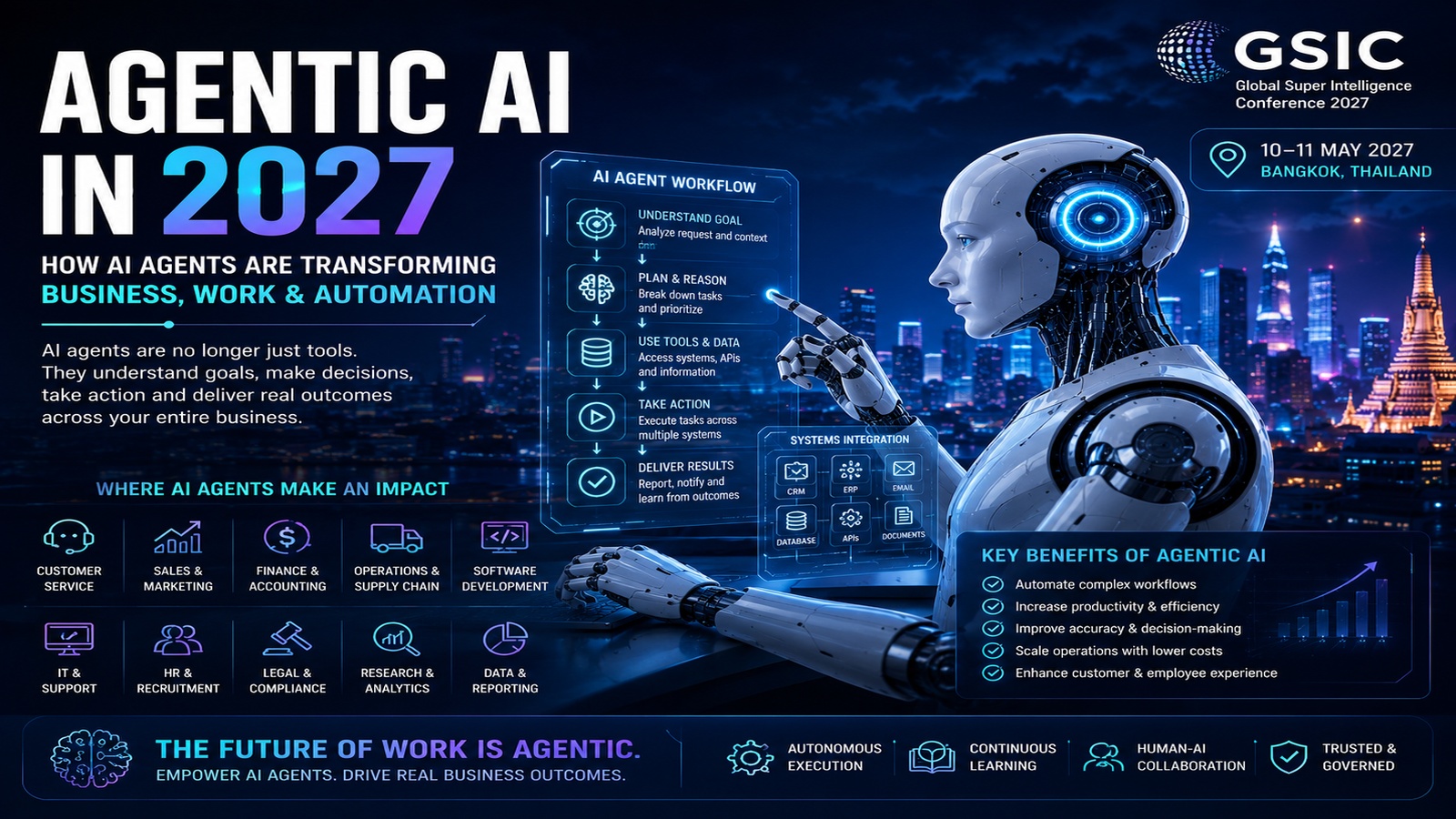
The Global Super Intelligence Conference 2027 in Bangkok provides a platform for discussions around frontier AI, agents and autonomy, AI infrastructure, AI safety and alignment, enterprise AI transformation and AI governance.
For organizations exploring the next stage of artificial intelligence, these discussions can help connect technological developments with real-world business challenges.
Agentic AI 2027: Key Trends to Watch
The most important developments to watch include:
AI agents moving into enterprise workflows
Specialized agents designed for specific business processes
Multi-agent collaboration
AI agents interacting across multiple applications
Agentic software interfaces
AI-powered business process automation
Human-agent collaboration
Agent security and identity management
AI agent governance and monitoring
Greater focus on measurable ROI
Together, these trends point toward a broader transformation in how organizations design work.
Frequently Asked Questions About Agentic AI in 2027
What is agentic AI?
Agentic AI refers to AI systems capable of pursuing defined goals by planning tasks, using tools, reasoning through problems and taking actions with varying levels of autonomy.
What are AI agents?
AI agents are software systems that can perform tasks or workflows on behalf of users or organizations. Depending on their design, they may retrieve information, make recommendations, interact with software and execute actions.
How will agentic AI affect businesses in 2027?
Agentic AI is expected to increasingly affect customer service, software development, finance, marketing, operations, IT, sales and other business functions by automating multi-step workflows.
Will AI agents replace employees?
The impact will vary by job and task. AI agents can automate certain activities, while employees may increasingly focus on judgment, strategy, creativity, relationships, oversight and complex decision-making.
What is the difference between AI assistants and AI agents?
AI assistants generally help users complete tasks through interaction. AI agents can operate with greater autonomy, potentially planning and executing multiple steps toward a defined objective.
What are multi-agent systems?
Multi-agent systems involve multiple AI agents with different capabilities or responsibilities working together to complete more complex objectives.
What are the biggest risks of agentic AI?
Important risks include security vulnerabilities, excessive permissions, unreliable decisions, data exposure, inadequate governance, poor integration, unexpected behavior and unclear accountability.
How can businesses prepare for agentic AI?
Businesses can begin by identifying suitable workflows, defining measurable objectives, establishing governance, controlling permissions, preparing employees and implementing monitoring before expanding deployments.
Is agentic AI the future of automation?
Agentic AI is an important emerging approach to automation because it can potentially handle more flexible and multi-step workflows than traditional rule-based systems. Its adoption will depend on reliability, cost, security, governance and measurable business value.
Where can businesses learn more about the future of AI agents?
AI conferences and technology events provide opportunities for business leaders, researchers, investors, policymakers and technology professionals to discuss agentic AI, enterprise AI, AI safety, governance and emerging technologies.
Conclusion: The Rise of the Agentic Enterprise
Agentic AI represents a significant evolution in the relationship between people, software and automation.
The previous generation of AI helped businesses generate, search and analyze information.
The emerging generation can increasingly plan, coordinate and act.
As organizations move into 2027, AI agents may become embedded in customer service, software development, operations, finance, marketing, cybersecurity and other business functions.
But successful adoption will require more than increasingly capable AI models.
Businesses will need reliable data, secure infrastructure, clear governance, employee training and measurable objectives.
The organizations exploring agentic AI should therefore ask a practical question:
Not “Where can we put an AI agent?” but “Which business outcomes can an AI agent safely and measurably improve?”
That shift—from AI experimentation to outcome-focused AI—could define the next stage of enterprise transformation.
And as agentic AI continues to evolve, the conversation around autonomous systems, AI safety, governance, infrastructure and superintelligence will become increasingly important for businesses and society.
The future of work may not simply be automated.
It may become agentic.